
Description
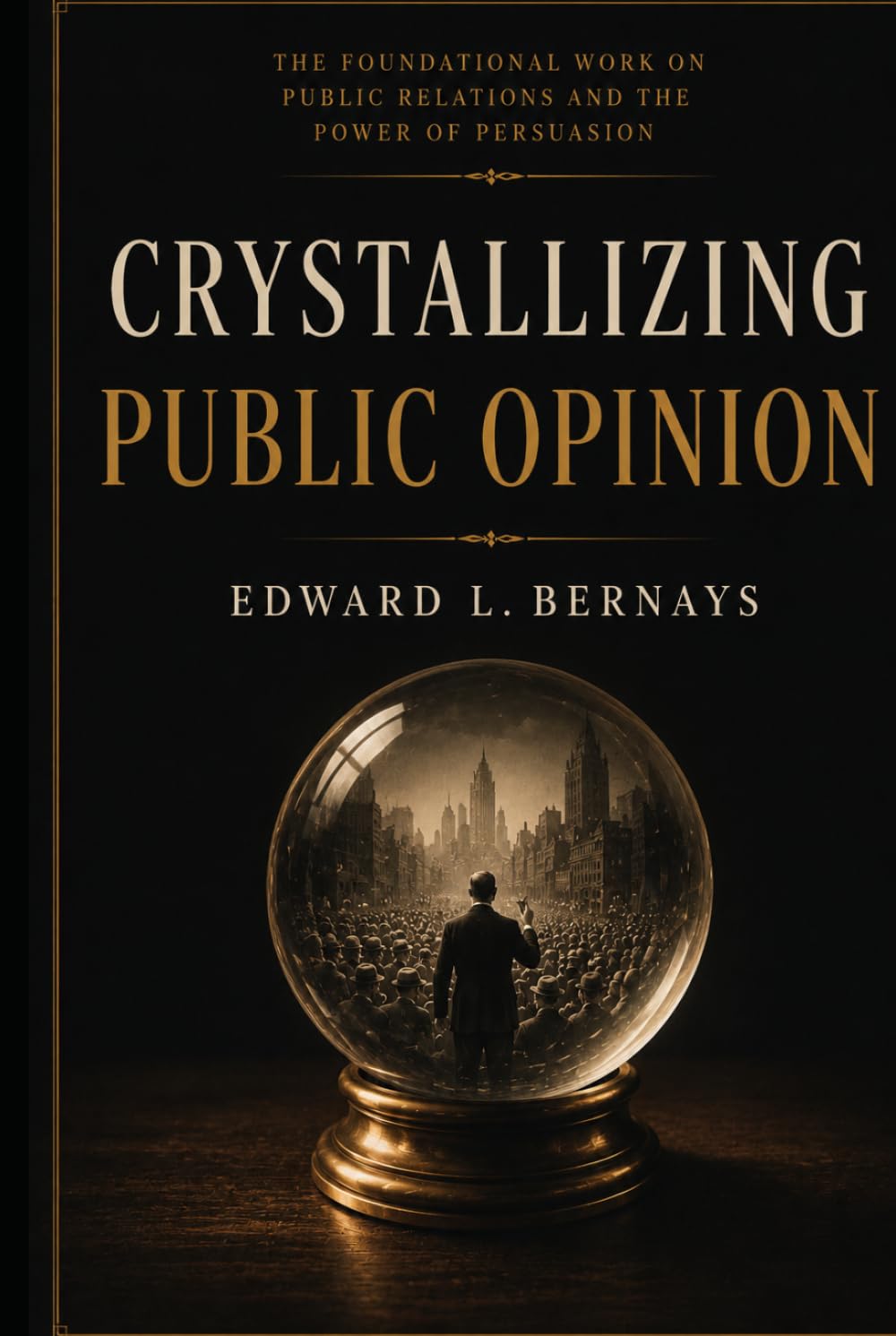
The book that helped define modern public relations. Long before social media, political consultants, corporate communications departments, and twenty-four-hour news cycles, Edward L. Bernays examined how institutions could influence what the public sees, discusses, and ultimately believes. First published in 1923, Crystallizing Public Opinion was one of the earliest systematic accounts of the emerging profession of public relations. Bernays argues that public opinion does not arise from isolated individual judgment alone. It is shaped by groups, inherited beliefs, authority figures, newspapers, social institutions, and carefully constructed events. Drawing on psychology, sociology, journalism, and his own professional experience, Bernays explains: • why organizations must understand the public before attempting to persuade it; • how news, publicity, and third-party authority influence perception; • why people often think and act as members of groups; • how the public relations counsel differs from the conventional press agent; and • how private interests attempt to secure public acceptance. Bernays presents public relations as a necessary intermediary between complex institutions and mass society. Modern readers may instead see in his arguments the foundations of corporate image management, political messaging, media manipulation, influencer strategy, and the deliberate manufacture of public consent. That unresolved tension is precisely what makes the book so important. Crystallizing Public Opinion remains essential reading for anyone interested in public relations, propaganda, advertising, political communication, mass psychology, media studies, or the history of persuasion. This carefully prepared edition includes: • a new introduction examining Bernays, his historical context, and the development of public relations; • explanatory endnotes for modern readers; • a biographical account of Edward L. Bernays; • selected further reading; and • a clean, professionally formatted text designed for comfortable reading. Read beside Walter Lippmann’s Public Opinion or Bernays’s later Propaganda, this foundational work reveals how the management of public perception became one of the defining forces of modern life.
More Information
| Gtin | 09798189932205 |
| Age_group | ADULT |
| Condition | NEW |
| Gender | UNISEX |
| Product_category | Gl_book |
| Google_product_category | Media > Books |
| Product_type | Books > Subjects > Politics & Social Sciences > Politics & Government > Specific Topics > Propaganda & Political Psychology |