
Description
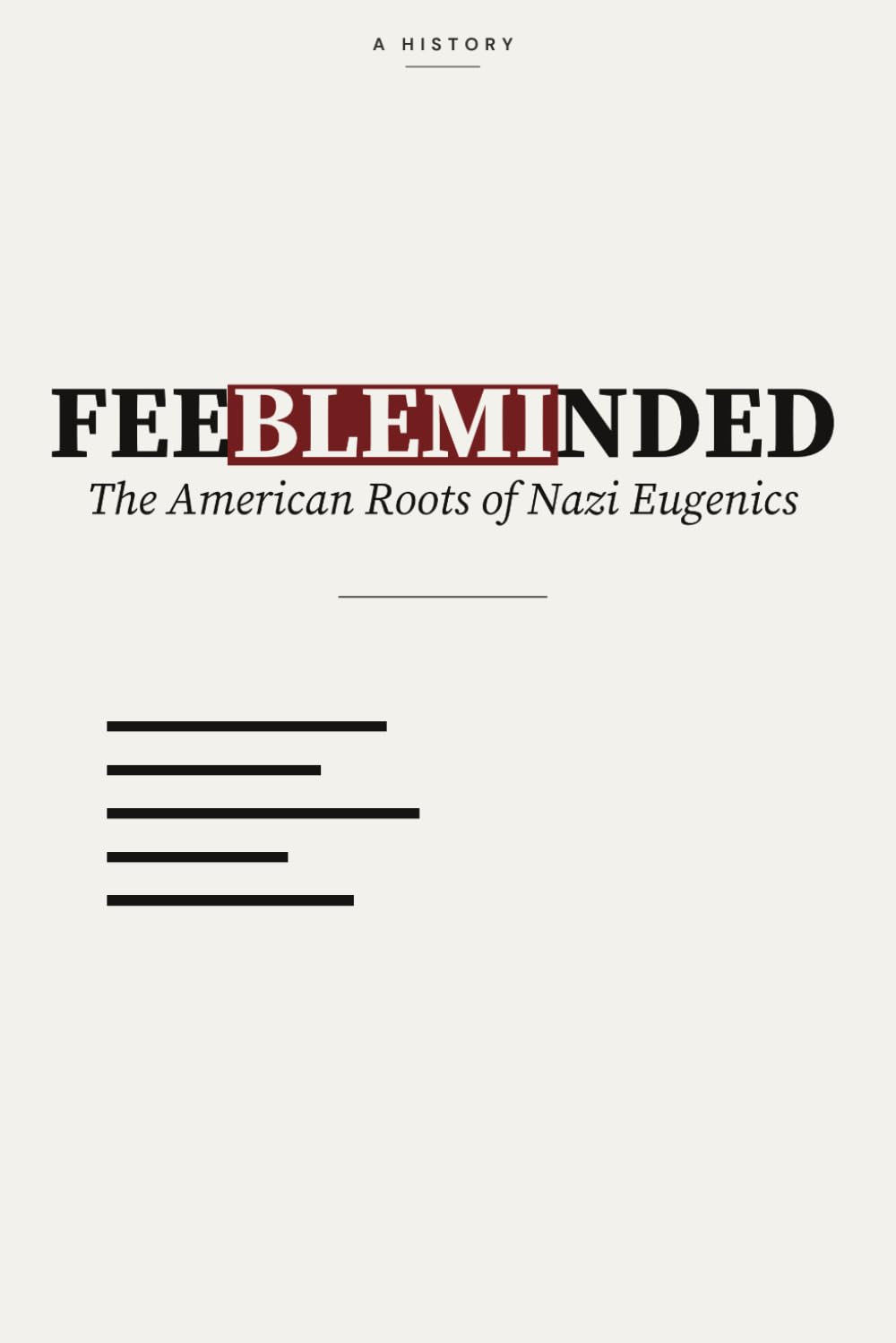
Before Adolf Hitler built his machinery of racial murder, he studied American law. What did the United States give Nazi Germany? Not just inspiration. The architects of the Third Reich's racial state borrowed directly from American statutes, American science, and American courts. They read the segregation codes of the American South. They cited a Supreme Court decision. They corresponded with American researchers and received their funding from American foundations. FEEBLEMINDED: The American Roots of Nazi Eugenics tells the story of that transfer, and asks a question the historical record forces us to confront: how much of the Holocaust was made in America? This book traces the eugenics movement from its origins in the Victorian theories of Francis Galton through the laboratories of Cold Spring Harbor, New York, where Charles Davenport and Harry Laughlin built the intellectual infrastructure of American racial science . Laughlin's model sterilization statute became the template for the Nazi sterilization law of 1933. In 1936, Heidelberg University awarded him an honorary doctorate for his contributions to " the science of racial cleansing. " The Rockefeller Foundation and the Carnegie Institution supplied the money that kept this science alive on both sides of the Atlantic. At the center of the American story stands Carrie Buck, a young Virginia woman forcibly sterilized by the state after the Supreme Court ruled in Buck v. Bell (1927) that the Constitution permitted such operations. That decision was never overturned. It was cited by Nazi defendants at Nuremberg. FEEBLEMINDED follows the line from those courtrooms to the T4 euthanasia program, which murdered disabled Germans in gas chambers between 1939 and 1941, and from T4 to the death camps. The personnel overlapped. The methods transferred. The logic was the same. The book does not end in 1945. It carries the argument forward through postwar sterilization programs, the population control movement, the controversy over The Bell Curve , and into the present, where prenatal screening, embryo selection, and gene-editing technology are advancing faster than the ethical frameworks meant to govern them. The assumptions eugenics created were never formally repudiated. They were absorbed. For readers of Edwin Black's War Against the Weak and James Q. Whitman's Hitler's American Model , this book is essential reading for anyone who wants to understand how scientific racism moves through institutions, survives catastrophe, and resurfaces in new forms. The history of eugenics is not a closed chapter. It is an unfinished argument, and we are still living inside it.
More Information
| Gtin | 09798181585034 |
| Age_group | ADULT |
| Condition | NEW |
| Gender | UNISEX |
| Product_category | Gl_book |
| Google_product_category | Media > Books |
| Product_type | Books > Subjects > History > Americas > United States > Immigrants |