
Description
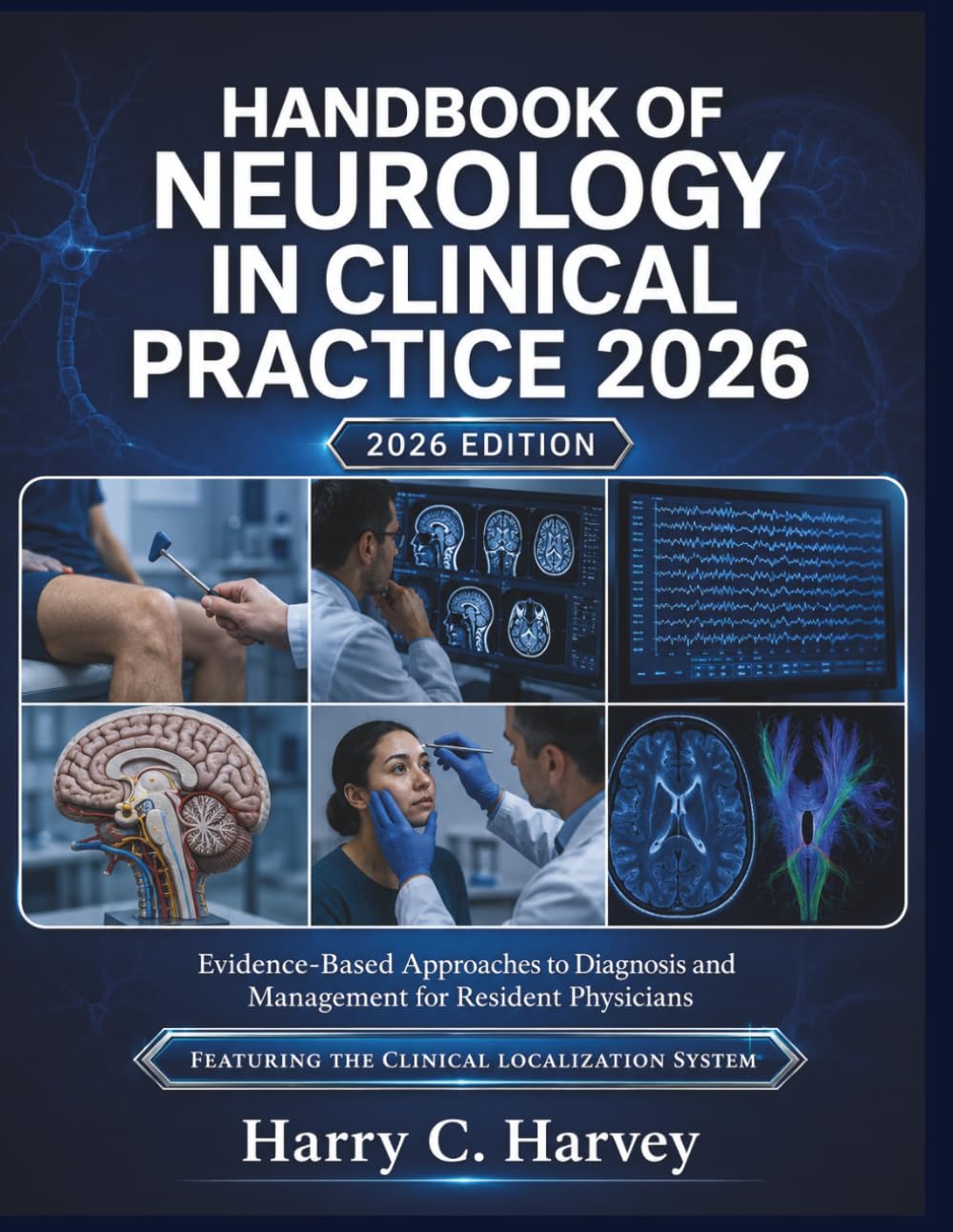
You are standing at the bedside of a 34-year-old woman with three days of progressive ataxia, an MRI that returns with longitudinally extensive T2 cord signal across four vertebral segments, and a registrar asking whether to start methylprednisolone now or wait for the AQP4 antibodies. The wrong call cascades — empirical steroids that compromise a future biopsy, a missed NMOSD relapse that scars the optic nerve, a "transverse myelitis" labelled idiopathic that returns six months later as MOG-associated disease. This handbook rebuilds your clinical reasoning around the framework that actually works at the bedside — localise first, narrow the differential by anatomy, then commit to the time-critical decision. • Localise before you image — the Clinical Localization System runs through all 30 chapters and consolidates in a 25-page anchor compendium indexed by anatomy, examination finding, and imaging pattern • Master the time-critical decisions — DAWN and DEFUSE-3 tissue-based thrombectomy selection out to 24 hours, the Stupp protocol with tumour-treating fields, the apnea test for brain death determination • Recognise the 2026 disease-modifying era — lecanemab and donanemab for Alzheimer's, vorasidenib for IDH-mutant glioma, tofersen for SOD1-ALS, the emerging orexin agonists for narcolepsy • Diagnose FND on positive signs — Hoover's, entrainment, eyes closed in functional seizures, with the DSM-5-TR framework that ends diagnosis by exclusion • Apply HINTS at the bedside — separate vestibular neuritis from posterior circulation stroke in the first 48 hours when DWI still misses the infarct • Navigate the new immune-related adverse events — checkpoint inhibitor encephalitis, the myasthenia-myositis-myocarditis triad, the syndromes oncology will refer to you next week • Deliver an FND diagnosis that heals rather than harms — the validated communication framework that improves outcomes Written for resident physicians, neurology fellows, hospitalists, internists, emergency physicians, advanced practice clinicians, and senior medical students engaged with neurological patients. Buy this handbook now and commit to the bedside reasoning your patients deserve. ⭐⭐⭐⭐⭐ The Localization Framework Alone Is Worth the Price What sets this handbook apart from every other resident reference on my shelf is the Clinical Localization System threaded through every chapter — anatomy isn't just a foundations topic, it's the spine of the entire book. Whether the chapter is on seizure semiology, MS plaque mapping, or herniation syndromes, the "where" question gets answered systematically. It's the way neurology should be taught. - Dr. Daniel R. Whitman, MD, Program Director, Adult Neurology Residency ⭐⭐⭐⭐⭐ Genuinely Current — Not a Reprint With a New Date on the Cover Calling a book "2026" means nothing if the evidence inside is five years old, but this one delivers. The lecanemab and donanemab sections handle ARIA management properly, the LVO thrombectomy selection criteria reflect the late-window trials, and the efgartigimod material in both MG and CIDP is exactly what residents are being pimped on right now. The integration of WHO 2021 CNS tumor molecular markers and the AT(N) biomarker framework into clinical decision-making is also handled with real fluency. - Dr. Rebecca Foster, MD, FAAN, Vascular Neurology Attending ⭐⭐⭐⭐ Built for the Way Residents Actually Learn The Summary and Key Concepts sections at the end of every chapter make this a viable rapid-review tool the week before RITE, not just a doorstop reference. Length and depth are calibrated for the trainee level — enough pathophysiology to understand, never so much that you lose the clinical thread. -Marcus T. Holloway, MSN, FNP-BC, Neuroscience Nurse Practitioner Educator ⭐⭐⭐⭐⭐ Strong on the Subspecialty Material Residents Usually Have to Piece Together The neuromuscular section deserves particular mention — the axonal-versus-demyelinating electrodiagnostic interpretation template, the MGFA classification with QMG scoring, and the El Escorial-to-Gold Coast comparison for ALS are all the level of detail residents normally have to assemble from three different sources. The autoimmune encephalitis antibody panel walkthrough — NMDAR, LGI1, CASPR2, AMPAR, GABA-B — is similarly clean. Practical, well-organized, and clinically anchored throughout. -Dr. Karen S. Mitchell, DO, Neuromuscular Medicine Specialist ⭐⭐⭐⭐⭐ A Trainee Reference That Respects the Reader's Intelligence Most resident handbooks either dumb things down or pile on detail without organization — this one does neither. The ICH-versus-SAH workups, the SNOOP4 red-flag framework, the status epilepticus phase-based protocol, and the Wernicke thiamine dosing pearls are all delivered with the right level of clinical specificity. I'll be recommending it to my interns on day one. - Dr. Jonathan A. Brennan, MD, MPH, Chief of Neurohospitalist Service
More Information
| Gtin | 09798197905666 |
| Age_group | ADULT |
| Condition | NEW |
| Gender | UNISEX |
| Product_category | Gl_book |
| Google_product_category | Media > Books |
| Product_type | Books > Subjects > Medical Books > Medicine > Internal Medicine > Neurology |