
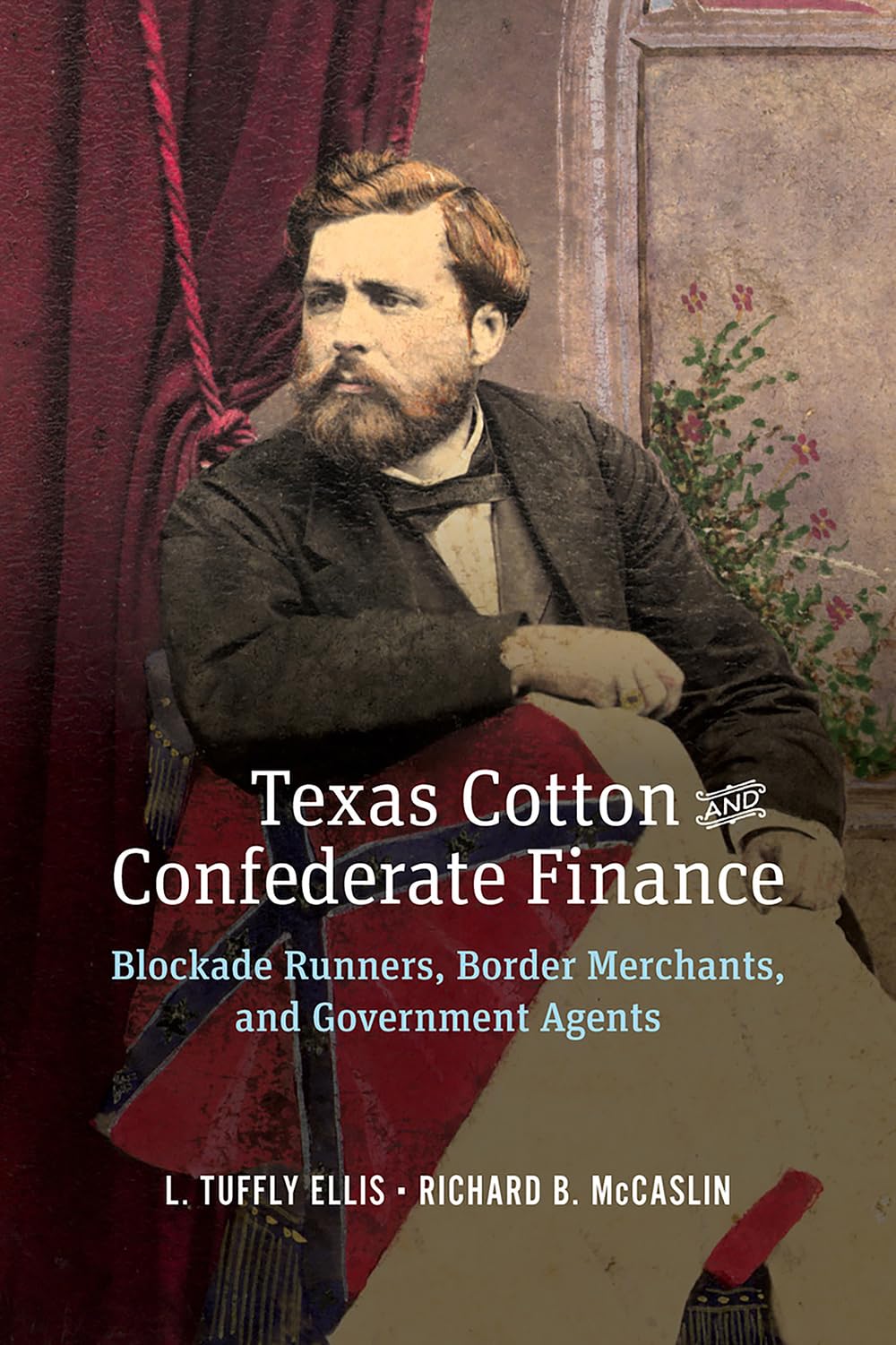
Texas Cotton and Confederate Finance: Blockade Runners, Border Merchants, and Government Agents (Volume 3) (Randolph B. “Mike” Campbell Series)($34.95Value)
$34.95
Texas Cotton and Confederate Finance: Blockade Runners, Border Merchants, and Government Agents (Volume 3) (Randolph B. “Mike” Campbell Series)($34.95Value)
Description
Gen. Edmund Kirby Smith, the commander of the Confederate Department of the Trans-Mississippi, wrote in January 1864 about the Cotton Bureau, “In my judgement it is destined to be one of the most powerful agencies upon which we must rely in the inevitable struggle for supremacy in this Department.” Kirby Smith had taken command of the department in 1863 only to discover that efforts to support the Confederate military in that region with cotton, the primary local resource, were failing. The Trans-Mississippi relied on cotton more than any other Confederate department, and Texas was the main source of cotton for the western Confederacy. Kirby Smith struggled to develop a better way to swap that commodity for military goods. The bureau became his principal supply agency, and it did remarkably well in tandem with other efforts to benefit from cotton. In the end Kirby Smith got far more from Texas cotton than he got from Richmond officials. This is an administrative history of efforts to exploit Texas cotton to sustain the Confederacy in the Trans-Mississippi. No one has previously published such a study, in part because the tale is incredibly complex. L. Tuffly Ellis began writing this history, and finishing the task fell to Richard B. McCaslin, his former doctoral student, after Ellis passed away. At first the Confederacy used private contractors during the first year of the war to move cotton, then at least two state agencies, a host of Confederate agents, the Cotton Bureau, and finally a branch office of the Confederate Treasury. There was also the Cotton Office, the most important subagency of the bureau, which operated from Houston. Unfortunately for the Confederates, they experienced as many lost opportunities as they did successes. The weak Union blockade offered a great opportunity, and lots of Texas cotton went overseas, but the Confederacy did not fully take advantage of these circumstances. During and after the war, stories circulated about corruption and fraud, but there is little evidence of that. Instead, the real flaws in the system were inefficiency and conflict. “Rather than focusing solely on military operations or the relatively minor skirmishes that occurred along the Gulf Coast, Ellis and McCaslin direct their attention to the economic, social, and political dynamics that shaped the lived experiences of the civilian population. In doing so they illuminate aspects of the Civil War that are often overlooked in conventional narratives but are arguably more representative of the issues that at least indirectly shaped the experiences of most Texans during the war, where money and business were built on the foundation of cotton production and processing. The challenge of how to convert cotton, perhaps the one thing that Texas and the Trans-Mississippi had plenty of, into the cash, raw materials, or munitions necessary to continue the war eventually became an all-consuming problem for both military leaders and public officials. The scope and depth of this study are unparalleled, marking it as a foundational contribution to the historiography of Civil War–era Texas.”― Andrew W. Hall , author of Civil War Blockade Running on the Texas Coast “This is the first book to explore the subject of cotton and Confederate policy to such a great extent. Cotton played an incredibly important part in the war west of the Mississippi, and its significance and the way military and government officials tried to harness it for military and political purposes have never been covered in depth before. The authors do a great job of tying together topics like blockade running and cotton policy and telling a broader and more important story.”― Edward T. Cotham Jr. , author of Battle on the Bay: The Civil War Struggle for Galveston and Sabine Pass: The Confederacy's Thermopylae “Finally! Richard McCaslin, the Texas state historian, has picked up the unfinished work of his mentor. Together they have untangled the Gordian knot that is the murky doings of the various cotton bureaus, agents, and efforts to finance the rump of the Confederacy that was hanging on west of the Mississippi. There is a renaissance of writing on Texas in the Civil War, and this work will be a crucial element.”― Donald S. Frazier , director of The Texas Center at Schreiner University and author of Blood on the Bayou: Vicksburg, Port Hudson, and the Trans-Mississippi L. TUFFLY ELLIS retired as an associate professor of Texas history from the University of Texas at Austin, where he earned his doctoral degree. A fourth-generation Texan, he served as the director of the Texas State Historical Association from 1977 to 1985 and also as the longtime editor of the Southwestern Historical Quarterly. His research focused on the cotton trade in Texas, about which he wrote several academic articles. RICHARD B. McCASLIN, retired TSHA Professor of Texas History at the University of North Texas, now serves as Texas state historian and director of publication
More Information
| Gtin | 09798898290146 |
| Age_group | ADULT |
| Condition | NEW |
| Gender | UNISEX |
| Product_category | Gl_book |
| Google_product_category | Media > Books |
| Product_type | Books > Subjects > History > Americas > United States > Civil War > Confederacy |