
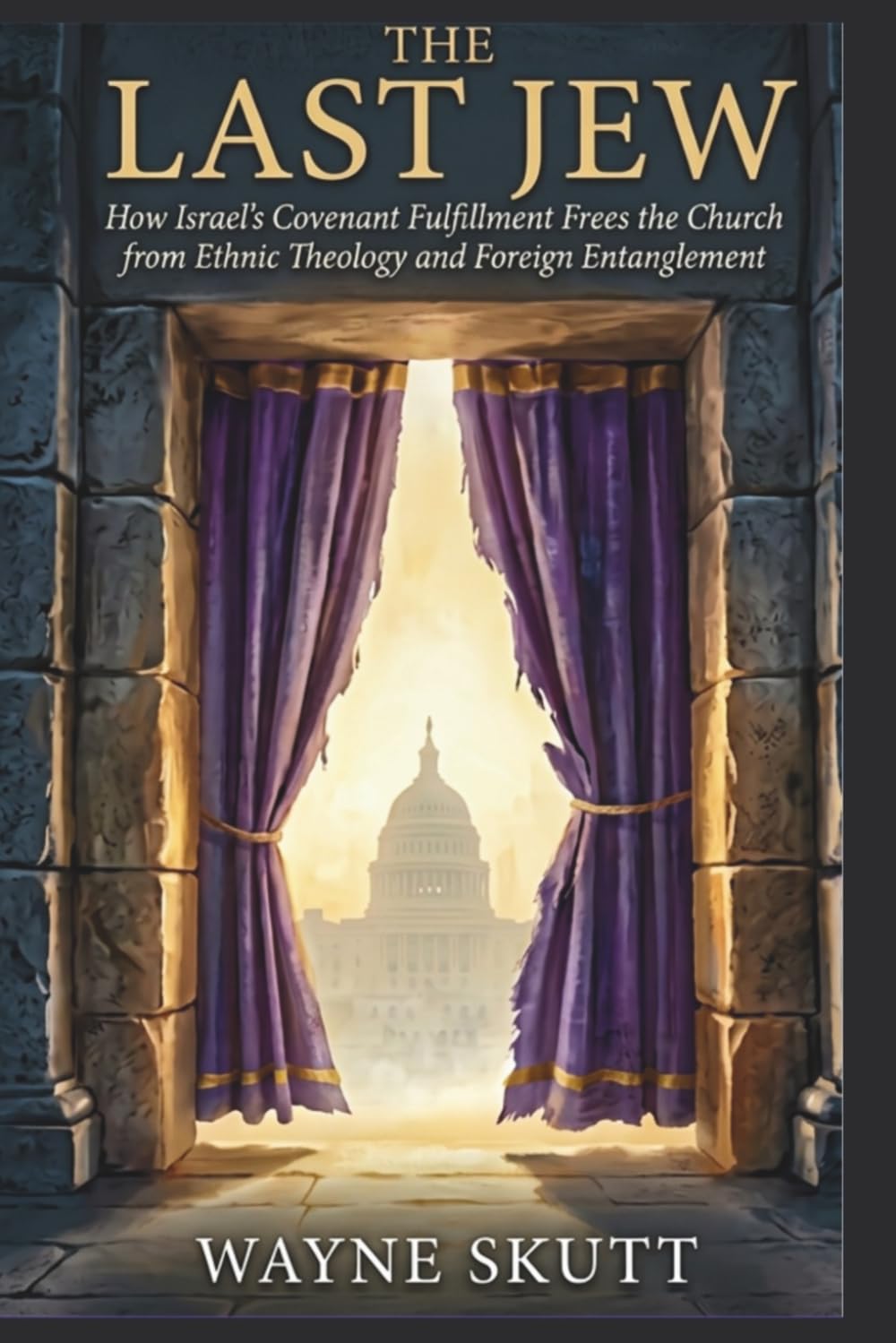
Description
What if the theological framework driving America's Middle East entanglements was invented in the 1830s by one man — and the previous eighteen centuries of Christian thought had never recognized it? The Last Jew makes a case that is at once historically precise, biblically grounded, and urgently civic. Wayne Skutt argues that Jesus of Nazareth was not merely a Jew among many Jews. He was the terminal fulfillment of the Abrahamic genealogical covenant — the one in whom two thousand years of carefully maintained genealogical records reached their appointed destination and were completed. Not abandoned. Not transferred. Completed, as a promise is completed when it is kept. That completion has consequences the contemporary church has largely refused to examine. When the covenant was fulfilled in Christ, the ethnic and genealogical hierarchy that structured the old covenant order was abolished. Paul declares it plainly: in Christ there is neither Jew nor Greek. The writer of Hebrews calls the old system complete, its purpose accomplished, the way to God now open to every person regardless of ancestry. The Jerusalem Council of Acts 15 confirms it apostolically. Eighteen centuries of Christian confessional consensus — from Justin Martyr through Augustine through Calvin — maintained it without controversy. Then in the 1830s John Nelson Darby introduced a system the prior tradition had never recognized. By 1909 Cyrus Scofield had printed it on the same page as Scripture and distributed it to every seminary in America. A century of institutional dominance followed. And Washington's warning — about the habitual fondness for a foreign nation driven by religious conviction rather than rational interest — has been fulfilled in the foreign policy of the most powerful republic on earth. The Last Jew traces the argument in order. The genealogical covenant from Abraham to Christ. The Incarnation and why it required a Jewish identity. The conditionality of the Mosaic covenant and the refiner's fire of disobedience that narrowed twelve tribes to two, two to one family, one family to one woman, one woman to one child. The torn veil and what it accomplished. Paul's framework and its apostolic authority. The origins of Christian Zionism and the hermeneutical inconsistency at its foundation. The constructive conclusion — one new man, no covenant hierarchy, every person equal before the God who hears oaths and judges oath-takers. The book ends where Washington's Farewell Address begins. The republic that endures will be the one that governs itself in the fear of the God whose plan the last Jew always was. Frederick Douglass understood it from a position of chains. The Separatists carried it across the Atlantic. Washington named it in 1796. The church's recovery of sound covenant theology is not a theological novelty. It is a return. And returns, however long delayed, are always possible. Published in the 250th year of American independence.
More Information
| Gtin | 09798995741404 |
| Age_group | ADULT |
| Condition | NEW |
| Gender | UNISEX |
| Product_category | Gl_book |
| Google_product_category | Media > Books |
| Product_type | Books > Subjects > History > Americas > United States > Revolution & Founding |