
Description
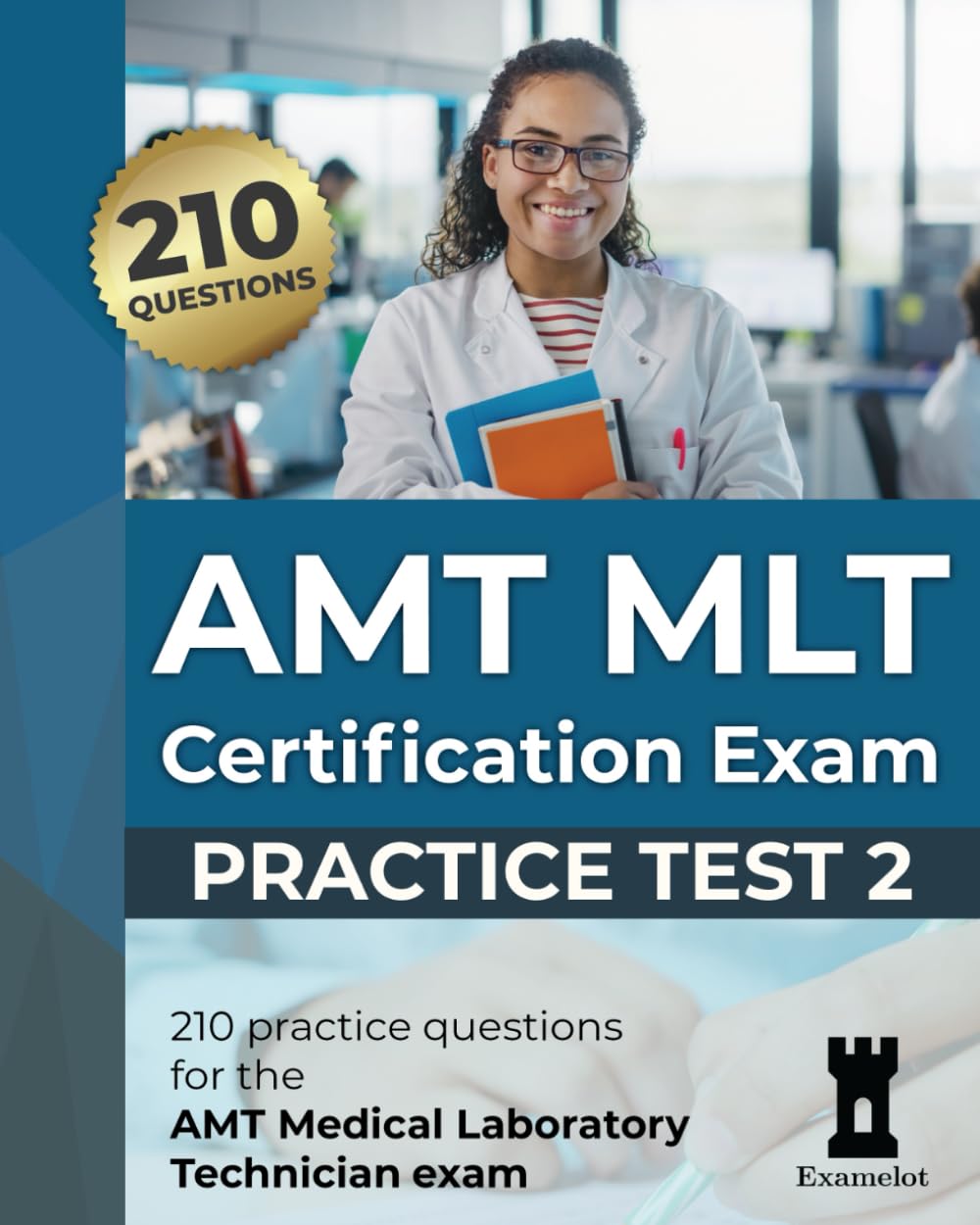
Prepare for the AMT Medical Laboratory Technician (MLT) exam with this second independent book of practice questions. This book contains: • 210 multiple-choice questions (all different from those in Practice Test 1) • Information about the AMT MLT exam The questions are divided into nine sections based on the nine Work Areas of the exam: 1. General Laboratory 2. Chemistry 3. Hematology 4. Coagulation and Hemostasis 5. Immunology and Serology 6. Immunohematology 7. Blood Banking and Transfusion Services 8. Microbiology 9. Urinalysis and Body Fluids Answers can be found at the end of each section, along with an explanation for trickier questions. ---SAMPLE QUESTIONS--- Here are seven sample questions from the book. 1) GENERAL LABORATORY A phlebotomist inserts a needle for venipuncture, but no blood flows into the collection tube. What is the most appropriate next step? a. Change to pediatric tubes b. Discontinue the draw and cancel the requisition c. Switch to a winged blood collection set d. Try adjusting the needle slightly Answer: d. Try adjusting the needle slightly Explanation: If no blood flows when the needle is in place, then the needle may not be in a vein. You should first try slightly manipulating the needle. If blood still does not flow, you should withdraw the needle and repeat the procedure. 2) CHEMISTRY Which term means the conversion of glycogen to glucose? a. Gluconeogenesis b. Glycogenesis c. Glycogenolysis d. Glycolysis Answer: c. Glycogenolysis Explanation: Glycogenolysis is the breakdown of glycogen into glucose. Lysis means "to break down". 3) HEMATOLOGY What is the preferred anticoagulant for red blood cell counts? a. EDTA b. Sodium citrate c. Heparin d. Sodium oxalate Answer: a. EDTA Explanation: EDTA is the best anticoagulant for preserving cells, and the preferred anticoagulant for red cell counts. 4) COAGULATION AND HEMOSTASIS What is the first step of hemostasis? a. Blood coagulation b. Temporary blockage of a break by a platelet plug c. Vasoconstriction d. Vasodilation Answer: c. Vasoconstriction Explanation: Hemostasis has three major steps: vasoconstriction, the temporary blockage of a break by a platelet plug, and blood coagulation. 5) IMMUNOLOGY AND SEROLOGY Which antibody does the body make first when it fights a new infection? a. IgA b. IgE c. IgG d. IgM Answer: d. IgM Explanation: IgM is the first antibody produced in response to an infection. Production of other antibodies, like IgG and IgA, begins a few days after an infection. 6) IMMUNOHEMATOLOGY Which type of bond joins light chains and heavy chains of antibodies together? a. Allene b. Disulfide c. Hydrogen d. Ionic Answer: b. Disulfide Explanation: Disulfide bonds are bonds between sulfur atoms. In antibodies, they hold the heavy and light chains together. 7) BLOOD BANKING AND TRANSFUSION SERVICES What is the minimum body weight required for blood donors? a. 50 kg b. 70 kg c. 80 kg d. 90 kg Answer: a. 50 kg Explanation: Most blood donation guidelines (such as those from the WHO and Red Cross) require donors to weigh at least 50 kg (about 110 lbs). This ensures the donor has enough blood volume to donate safely.
More Information
| Gtin | 09798244981889 |
| Age_group | ADULT |
| Condition | NEW |
| Gender | UNISEX |
| Product_category | Gl_book |
| Google_product_category | Media > Books |
| Product_type | Books > Subjects > Education & Teaching > Studying & Workbooks > Workbooks |