
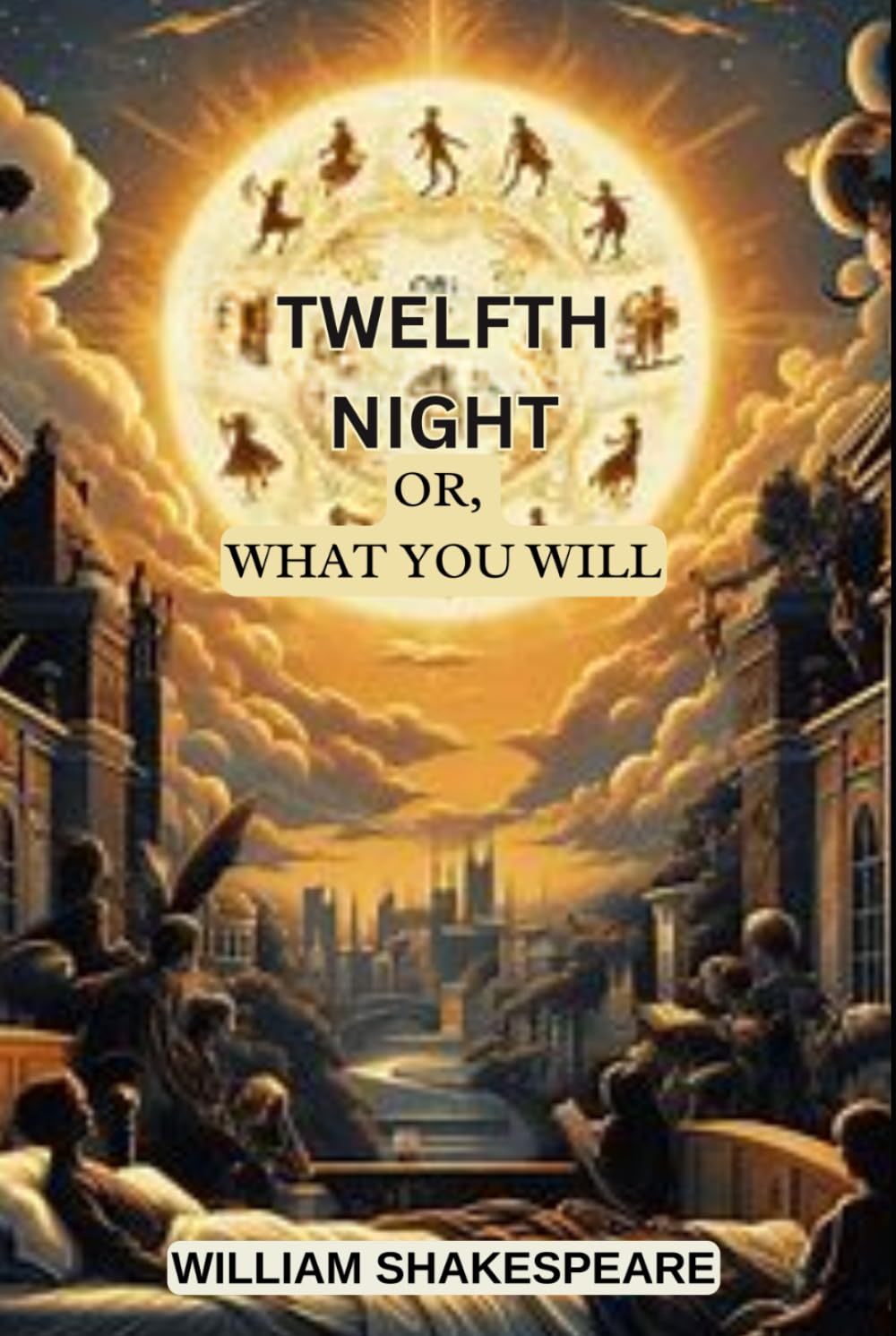
Description
"Twelfth Night, or What You Will" is a comedy by William Shakespeare, believed to have been written around 1601–1602 as a Twelfth Night's entertainment for the close of the Christmas season. The play centers on themes of love, identity, mistaken identity, and the revelry that surrounds the Twelfth Night holiday (the Feast of Epiphany). The story begins with a shipwreck in which Viola, a young noblewoman, is separated from her twin brother, Sebastian, each believing the other to be dead. Viola disguises herself as a young man named Cesario and finds employment with Duke Orsino. Orsino is deeply in love with the Countess Olivia, who mourns her brother's recent death and refuses all suitors. Orsino uses Viola (Cesario) as an intermediary to profess his love for Olivia. However, complications arise when Olivia, unaware of Cesario’s true identity, falls in love with Viola. Meanwhile, Viola has fallen in love with Duke Orsino, creating a complicated love triangle. As these romantic entanglements unfold, the play also follows a subplot involving members of Olivia's household: her pompous steward, Malvolio, her uncle, Sir Toby Belch, his friend Sir Andrew Aguecheek, her maid, Maria, and her fool, Feste. Together, they concoct various schemes that lead to humorous situations and misunderstandings. Malvolio is the focus of a particularly cruel trick, as Maria, Sir Toby, and others trick him into believing that Olivia loves him. This leads to Malvolio behaving bizarrely to win her over, for which he is locked up as a madman. The subplot provides a satirical counterpoint to the romantic main plot, offering commentary on social ambition and class behavior. The play moves towards resolution when Sebastian, Viola’s twin, arrives in Illyria, leading to a series of mistaken identities and near misses. Eventually, the siblings recognize each other, and all misunderstandings are cleared up. Orsino proposes to Viola, now revealed as a woman. Olivia marries Sebastian, whom she thinks is Cesario. Even Sir Toby marries Maria in recognition of her witty scheme. "Twelfth Night" is celebrated for its complex interplay of themes and its rich characterizations. Its explorations of love, gender, and identity, coupled with its dramatic irony and farcical elements, make it one of Shakespeare’s most beloved and frequently performed comedies. The play’s title, suggesting a celebration of misrule and festivity, perfectly captures its festive spirit and chaotic hilarity.
More Information
| Gtin | 09798335197410 |
| Age_group | ADULT |
| Condition | NEW |
| Gender | UNISEX |
| Product_category | Gl_book |
| Google_product_category | Media > Books |
| Product_type | Books > Subjects > Literature & Fiction > Dramas & Plays > Type > Comedy |