
Description
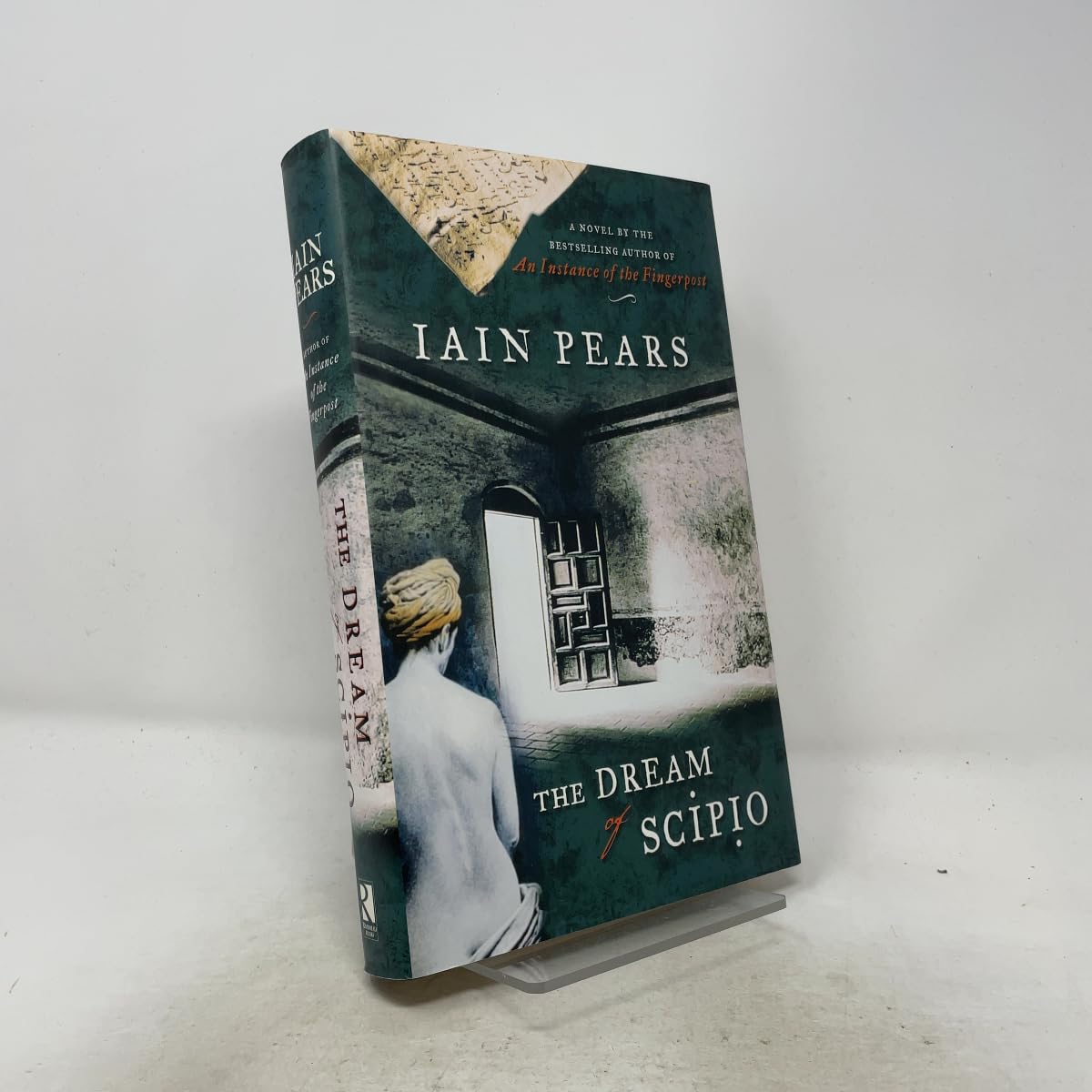
An ancient manuscript called "The Dream of Scipio" that explores timeless philosophical questions links three separate centuries--the fifth, the end of the Roman Empire; the fourteenth, the time of the Black Death; and the twentieth during World War II--and three stories of love, all set in Provence. 125,000 first printing. Like his elegant debut, An Instance of the Fingerpost , Iain Pears's The Dream of Scipio is an inventive, gloriously detailed historical novel told from multiple viewpoints. But Pears has set himself an additional challenge by spreading his narrators over several centuries: there's the fifth century French nobleman and bishop, Manlius, a civilized man who has embraced the uncouth Christian faith in order to protect what he holds dear; an 11th-century scholar and troubadour named Olivier de Noyen, the famously ill-fated admirer of a married girl; and Julien Barneuve, an early 20th-century scholar of de Noyen who discovers, through him, a magnificent manuscript of Manlius's called "The Dream of Scipio." Though all three men come from the same small Provençal town, it is this manuscript, derived from the teachings of a wise woman, that links the three narrative threads of Pears's story. At the heart of The Dream of Scipio and, one suspects, at the heart of its author, is the conflict between a classical ideal of learning and the contemplation of beauty, and the noisy, uncivilized, democratizing impulses of the Christian era. A novel of ideas like its predecessor, The Dream of Scipio is neither chilly nor didactic and doesn't shy away from depicting the costs of its narrators' unpopular devotions. --Regina Marler In the 400s, as the Roman Empire settles into dust, landowner-turned-bishop Manlius attempts to record the ideas of his teacher, the Neo-Platonist Sophia. In the 1300s, this treatise ("The Dream of Scipio") is discovered by poet Olivier de Noyen, whose efforts to understand it lead him to a learned Jew and a secret love that forces upon him a momentous moral decision while the plague ravages the countryside. In the 1930s, Julien Barneuve encounters de Noyen and his references to the wondrous treatise, even as the Holocaust looms and Barneuve struggles desperately to protect the woman he loves a painter and a Jew. The writing here is not as felicitous as in Pears's magisterial An Instance of the Fingerpost, but the plotting is a marvel; the text moves smoothly among the three eras, drawing parallels that rarely seem forced. In the end, Pears asks good, cutting questions about the idea of civilization, showing that those who claim to preserve it are often its worst enemies. Most libraries will want this. - Barbara Hoffert, "Library Journal" Copyright 2002 Cahners Business Information, Inc. (*Starred Review*) Readers of An Instance of the Fingerpost (1997) know that Pears possesses a remarkable ability to portray intimate human drama against a vast historical canvas. They also know that his real subject is not just history but the history of ideas and, more specifically, the ever-delicate, sometimes lethal relationship between thought and action. His latest grand-scale historical thriller is even more ambitious (and more beyond genre) than Fingerpost , which tackled the Restoration and the birth of modern science. This time he juggles three different historical periods, radically different but united by the presence of a siege--the fall of the Roman Empire in the fourth century, the spread of the plague in the fourteenth century, and World War II in the twentieth century. The setting in all three interlocking plots is Provence, and there is a love story at the center of each. The fabric that connects the characters and their stories across centuries is a neo-Platonic essay called "The Dream of Scipio" written by Manlius Hippomanes at the point when Gaul was about to be overrun by barbarians. Questions of engagement versus retreat, the contemplative life versus the active one, and the individual good versus the greater good come into play as, first, a Christian scholar in the fourteenth century and, then, a classicist in the 1940s formulate interpretations of Manlius' words, which translate into radical action. As Pears juggles these stories and themes in extremely complex but immensely satisfying three-part harmony, we come to see how actions both abominable and compassionate spring from the same idea. Pears' elaborate narrative triptych is dazzling for its structure, its complexity, and the richness of thought that gives it texture. But, finally, it is the passion of the love stories, undercutting bloodless philosophy while embracing the messiness of life, that lets the novel soar. Bill Ott Copyright © American Library Association. All rights reserved ...Iain Pears has constructed a splendid novel ... -- Neward Star-Ledger ...it is Pears's finest book yet, even more successful and riveting than its predecessor. -- Boston Globe The Dream of Scipio is complex, su
More Information
| Gtin | 9781573222020 |
| Mpn | DW-I51M-9AZL |
| Age_group | ADULT |
| Condition | NEW |
| Gender | UNISEX |
| Product_category | Gl_book |
| Google_product_category | Media > Books |
| Product_type | Books > Subjects > Literature & Fiction > Genre Fiction > Historical |