
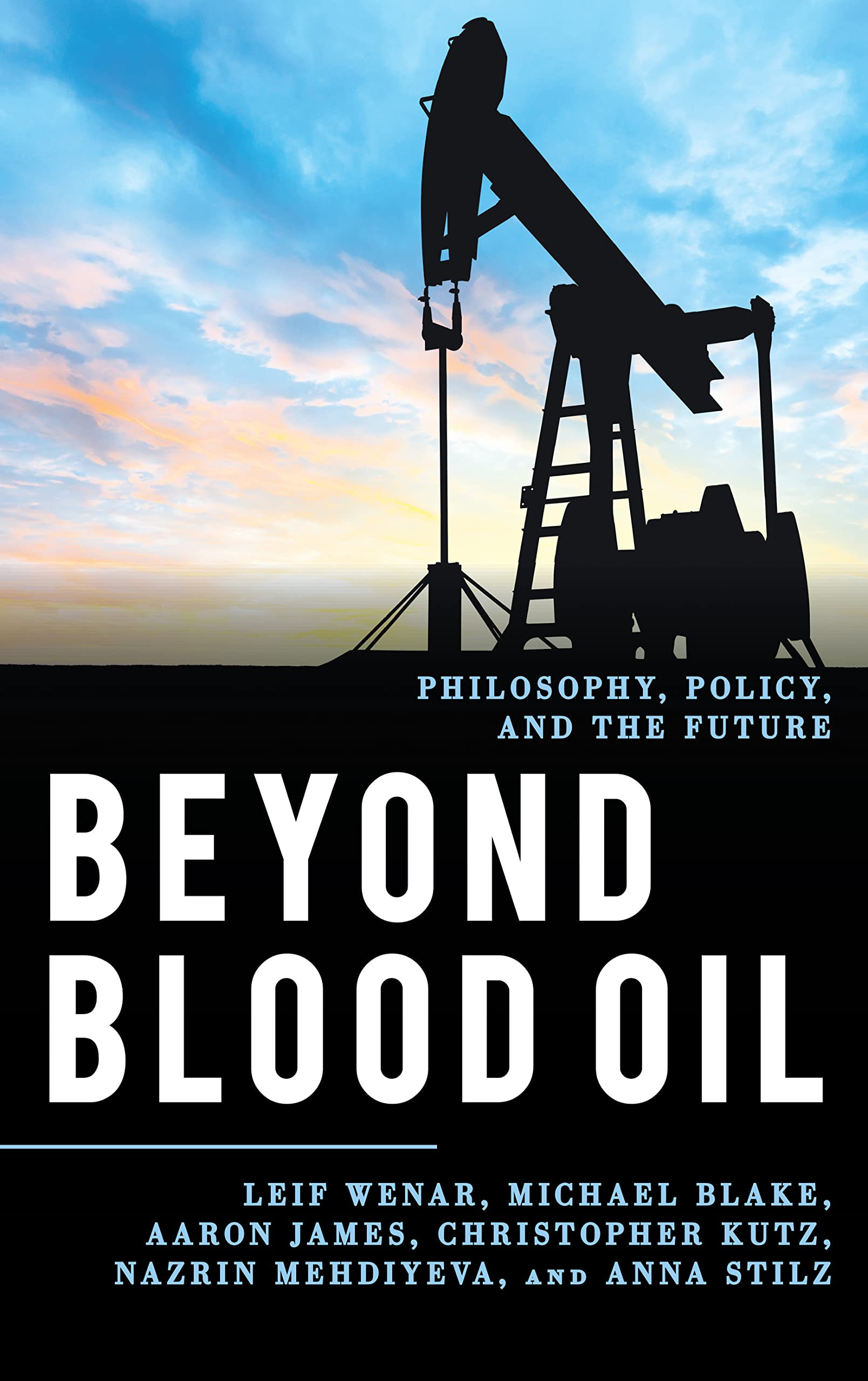
Description
Beyond Blood Oil expands on the themes and proposals laid out in Leif Wenar’s previous book and engages a distinguished group of scholars to explore philosophical arguments, assessing the prospects of his practical policy proposal. The book addresses how oil resources can undermine democracy and discusses moral obligations of those who consume oil. “Beyond Blood Oil is a compelling book with new insights. Clean energy is both essential for healthy global ecology and crucial to an effective response to Blood Oil.” ―Robert O. Keohane, Princeton University “Leif Wenar and colleagues offer an ingenious proposal for making trade in natural resources morally acceptable. This volume is engaged public philosophy at its very best.” ―Debra Satz, Stanford University “Corruption in oil, gas, and mining is rampant across the globe. This ‘must read’ book goes to the core security imperatives for international action and provides vital pathways to progress.” ―Frank Vogl, Transparency International, author "Waging War on Corruption" “Leif Wenar’s Blood Oil showed that we are complicit in the purchase of stolen goods, and that this complicity has disastrous consequences. Now, in Beyond Blood Oil, he and his interlocutors take that debate further, probing its foundations as well as its broader ramifications. This is an important book on a crucial issue.” ―Peter Singer, Ira W. DeCamp Professor of Bioethics, Princeton University and author of One World Now Leif Wenar is chair of philosophy and law at King’s College London. Michael Blake is professor of philosophy, public policy, and governance at the University of Washington. Aaron James is professor of philosophy at the University of California, Irvine. Christopher Kutz is C. William Maxeiner Distinguished Professor of Law at the University of California, Berkeley. Nazrin Mehdiyeva is an independent scholar, consultant, and specialist in energy security and geopolitics. Anna Stilz is Laurance S. Rockefeller Professor of Politics and the University Center for Human Values at Princeton University. Beyond Blood Oil Philosophy, Policy, and the Future By Leif Wenar, Michael Blake, Aaron James, Christopher Kutz, Nazrin Mehdiyeva, Anna Stilz Rowman & Littlefield Publishing Group, Inc Copyright © 2018 The Rowman & Littlefield Publishing Group, Inc. All rights reserved. ISBN: 978-1-5381-1210-6 Contents Foreword, vii, 1 Beyond Blood Oil By Leif Wenar, 1, 2 Bad Men and Dirty Trade By Michael Blake, 37, 3 The West's Energy Trap: Can It Be Broken? By Nazrin Mehdiyeva, 51, 4 Collective Resource Control and the Power of Complicity By Christopher Kutz, 73, 5 Does a Country Belong to Its People? By Anna Stilz, 89, 6 Why States Must Remedy the Resource Curse By Aaron James, 105, Replies to Critics by Leif Wenar:, 7 Reply to Blake and Mehdiyeva, 119, 8 Reply to Kutz, 133, 9 Reply to Stilz, 143, 10 Reply to James, 149, Notes, 157, Index, 183, About the Authors, 193, CHAPTER 1 Beyond Blood Oil Leif Wenar Natural resources empower the world's most coercive men. Autocrats from Russia to Algeria spend resource money on weapons and repression. Armed groups like ISIS and the Congo's militias have spent resource money on atrocities and ammunition. For decades the West's worst threats and crises have come from resource-enriched autocrats and armed groups — and the ultimate source of their resource money is consumers, paying at the gas station and the mall. The first part of this chapter analyzes the law, economics, and politics of the "resource curse." The deepest cause of this curse is an ancient rule that once licensed the slave trade, apartheid, and genocide. The abolition of this rule has marked humanity's greatest moral progress — yet the rule lingers in today's multi-trillion-dollar trade in resources, endowing despots and extremists with unaccountable power. The first part explains why the resource curse is a systemic global problem, and also where the solution to it must be. The second part sets out national policies that can lift the curse. These peaceful policies will make us more secure at home, more trusted abroad, and better able to work across borders to solve urgent problems like climate change. The third part of the chapter is intended for readers who are interested in more abstract issues, such as the nature of the principles that should guide the reform of global institutions, what is most important in distributive justice, and what values are ultimately worth pursuing. ANALYSIS OF THE RESOURCE CURSE In 2014, Iraq became a war of oil against oil. The Kurds and the Iraqi government both controlled large oil fields, and ISIS, which fought both, became "the world's richest terror army" by selling up to $1 million of crude a day. ISIS spent its oil money on genocidal assaults against the Yazidis, a horror-filled global propaganda campaign, and the military seizure of more oil fields in Syria. Meanwhile, Syria's oil-funded autocrat, Bashar
More Information
| Gtin | 09781538112106 |
| Mpn | 32343949 |
| Age_group | ADULT |
| Condition | NEW |
| Gender | UNISEX |
| Product_category | Gl_book |
| Google_product_category | Media > Books |
| Product_type | Books > Subjects > Business & Money > Industries > Energy & Mining > Oil & Energy |