
Description
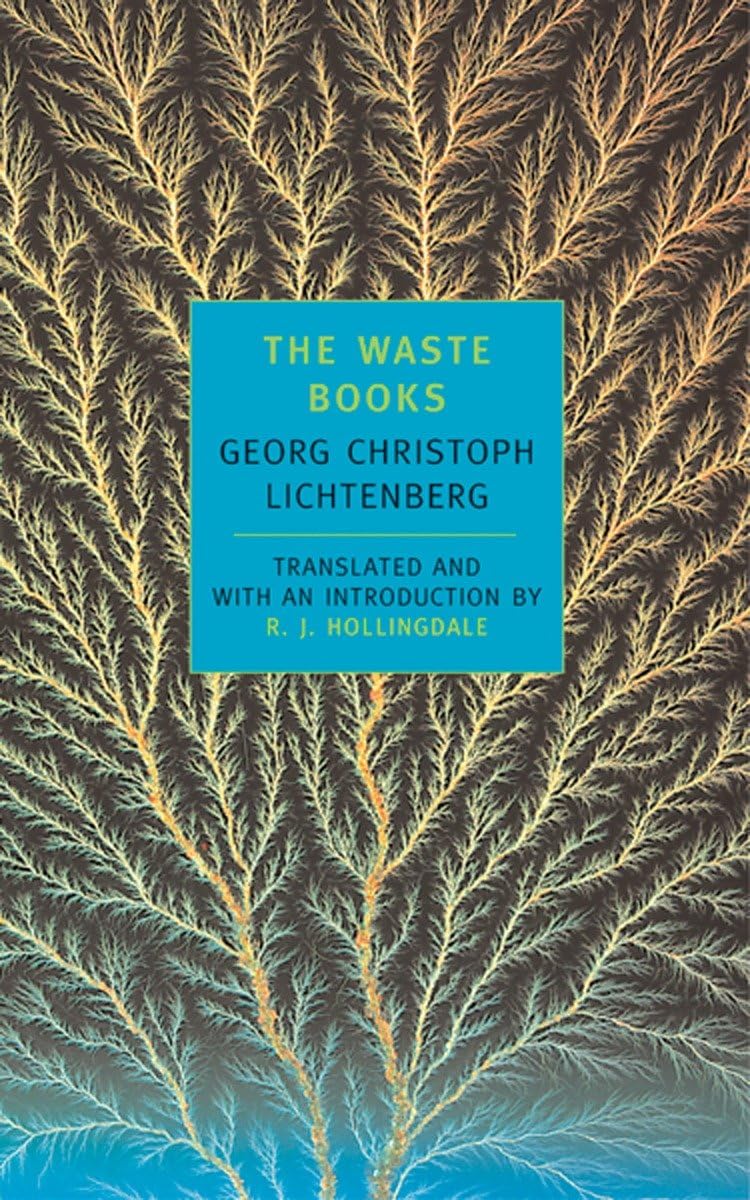
German scientist and man of letters Georg Christoph Lichtenberg was an 18th-century polymath: an experimental physicist, an astronomer, a mathematician, a practicing critic both of art and literature. He is most celebrated, however, for the casual notes and aphorisms that he collected in what he called his Waste Books. With unflagging intelligence and encyclopedic curiosity, Lichtenberg wittily deflates the pretensions of learning and society, examines a range of philosophical questions, and tracks his own thoughts down hidden pathways to disconcerting and sometimes hilarious conclusions. Lichtenberg's Waste Books have been greatly admired by writers as very different as Tolstoy, Einstein, and Andre Breton, while Nietzsche and Wittgenstein acknowledged them as a significant inspiration for their own radical work in philosophy. The record of a brilliant and subtle mind in action, The Waste Books are above all a powerful testament to the necessity, and pleasure, of unfettered thought. Odd title, unusual book. Lichtenberg (1742-1799) was a German polymath: astronomer, experimental physicist, mathematician and critic of art and literature. In his student days he began the lifelong practice of recording his thoughts, observations and reminders in notebooks that he called Sudelb¸cher after the "waste books" in which English business houses of the time entered transactions temporarily until they could be recorded in formal account books. By the end of his life he had accumulated 11 Sudelb¸cher, which he labeled as volumes A through L (skipping I). Hollingdale, a translator of Nietzsche, Goethe and Schopenhauer, has translated the notebooks. Here he presents excerpts, focusing on what he says are best called aphorisms. Lichtenberg turns out to be quite an aphorist, repeatedly surprising and entertaining the modern reader. Examples: "Whenever he was required to use his reason he felt like someone who had always used his right hand but was now required to do something with his left." "You can make a good living from soothsaying but not from truthsaying." "The book which most deserved to be banned would be a catalog of banned books." "Astronomy is perhaps the science whose discoveries owe least to chance, in which human understanding appears in its whole magnitude, and through which man can best learn how small he is." EDITORS OF SCIENTIFIC AMERICAN ''Among the great achievements of the German spirit.'' -- Gordon Craig, author of The Germans ''One of the most compulsively readable books to come out of the 18th-century German Enlightenment.'' -- The Vancouver Sun Georg Christoph Lichtenberg was born in 1742 in Oberramstadt, Germany. In 1763 he joined the University of Gottingen where he studied mathematics and the natural sciences and, in 1770 was appointed a professor at the university. In addition to his scientific writings, he wrote Letters from England and a book on Hogarth’s etchings. Lichtenberg died in 1799. R.J. Hollingdale (1930-2001) was born in London and after serving in the RAF became a prominent scholar and biographer of Nietzsche. Among his many translations are Nietzsche’s Thus Spoke Zarathustra , Ecce Homo , Twilight of the Idols , The Anti-Christ , and Beyond Good and Evil ; A Nietzsche Reader ; Goethe’s Elective Affinities ; Schopenhauer’s Essays and Aphorisms ; and a selection of Hoffmann’s Tales .
More Information
| Color | Multicolor |
| Gtin | 09780940322509 |
| Mpn | 9780940322509 |
| Age_group | ADULT |
| Condition | NEW |
| Gender | UNISEX |
| Product_category | Gl_book |