
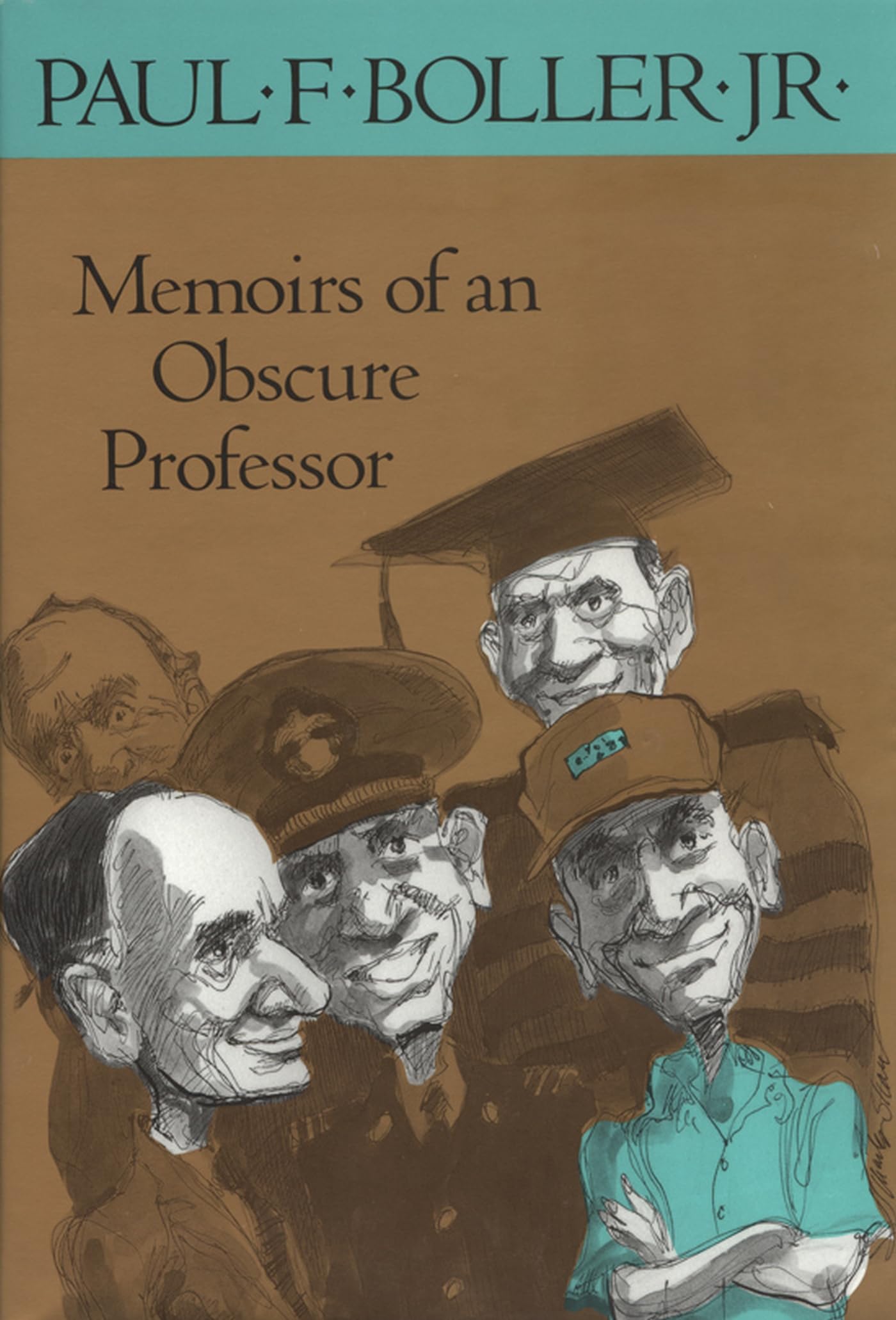
Description
During the heyday of McCarthyism, the Chicago Tribune , offended by something he had written, contemptuously dismissed Paul Boller as "an obscure professor" - he was then teaching at Southern Methodist University in Dallas, Texas. Some forty-five years later, reflecting on the incident, Boller wrote an essay on what it was like to be an obscure professor at one of America's less publicized campuses in a conservative community during the late 1950s and early 1960s. That essay became the foundation for this collection of autobiographical selections reflecting the interests and pursuits of a man who gained national recognition, both inside the academic community and beyond, but still values his obscurity. Whether it is a study of the much-maligned Calvin Coolidge or an account of his Navy service as a translator of Japanese during World War II, Boller brings to his writing a fresh approach and a lively and wry wit. Here is a collection of biographical essays dealing with Boller's experiences as a student at Yale, a World War II naval officer (handling Japanese prisoners of war), and a professor of history. Topics range widely from film music, H.L. Mencken's Americana , and Calvin Coolidge to Lyndon B. Johnson's quoting habits and reactions to the bombing of Hiroshima in 1945. All reflect a lively and inquiring mind and a dedication to liberal causes and politics. The title was derived from a 1953 incident in which the Chicago Tribune took umbrage at something the author had written and contemptuously dismissed him as "an obscure professor." This book will be of great interest to readers who remember World War II and to those with an intellectual turn of mind and a liberal bent in politics. Lay readers will also enjoy Boller's memories of teaching at Southern Methodist University, the University of Massachusetts, and Texas Christian University. -Samuel T. Huang, Northern Illinois Univ. Libs., DeKalb Copyright 1992 Reed Business Information, Inc. Memoirs of an Obscure Professor and Other Essays By Paul F. Boller Jr. TCU Press Copyright © 1992 Paul F. Boller, Jr. All rights reserved. ISBN: 978-0-87565-097-5 Contents Acknowledgments, Preface, 1 Memoirs of an Obscure Professor: McCarthy Days in Texas, 2 Some Brushes with History: Handling the Japanese Language During World War II, 3 Movie Music: The Sound of Silents, 4 The Bright Side of Calvinism: Those Coolidge Stories, 5 Purlings and Platitudes: H. L. Mencken's Americana, 6 The Quotatious Lyndon B. Johnson, 7 History and War: Beard and Batault, 8 Hiroshima and the American Left: August 1945, 9 Academic Anecdotes, 10 Afterthoughts, A Note on Sources, Index, CHAPTER 1 Memoirs of an Obscure Professor: McCarthy Days in Texas How does one begin a memoir? Augustine started off by invoking his God. So did Rousseau, but he made it clear that the deity he adored had to take him on his own terms: good, bad, indifferent. Rousseau's way of putting it amused Henry Adams, but Adams skipped the invocation and simply announced his birth date and then stated the theme of his book: he was a child of the seventeenth and eighteenth centuries required to play the game of the twentieth. Benjamin Franklin was pedagogical (and a bit proud); he wanted to show his son, he said, how he rose from "Poverty and Obscurity" to "a State of Affluence and some degree of Reputation in the world." Lincoln Steffens was cutesy; he was born in San Francisco, he wrote, "a remarkable child," according to his mother, "a remarkable woman." Benevenuto Cellini was solemn. "All men of whatsoever quality they be, who have done anything of excellence, or which may properly resemble excellence," he declared, "ought, if they are persons of truth and honesty, to describe their life with their own hand; but they ought not to attempt so fine an enterprise until they have passed the age of forty." Well, I'm past forty—way past it, in fact—and perhaps it is time to say something, that is, if I have something to say, and I think I do. But the gifted men whose memoirs I have just cited are men of fame; they are what the present era calls celebrities. How does a mere obscurity—"an obscure professor"—commence his remembrances of things past, especially when he plans to confine them to a short period in his life: his encounter with McCarthyism in Texas in the 1950s and 1960s? Perhaps the best strategy is to start by explaining the appellation. The Chicago Tribune , ultra-conservative Robert R. McCormick's pride and joy, did the christening, and did so when I was just beginning my academic career. Not long after I took my doctorate at Yale and began teaching history at Southern Methodist University, the Tribune huffily dismissed me as "an obscure professor" in an editorial attack on an article I wrote in 1953 defending Franklin Roosevelt's 1933 inauguration of diplomatic relations with the Soviet Union. I was already being referred to as a "junior personality" by John O.
More Information
| Gtin | 09780875650975 |
| Mpn | RKC2010713208 |
| Age_group | ADULT |
| Condition | NEW |
| Gender | UNISEX |
| Product_category | Gl_book |
| Google_product_category | Media > Books |
| Product_type | Books > Subjects > Biographies & Memoirs > Historical > United States |