
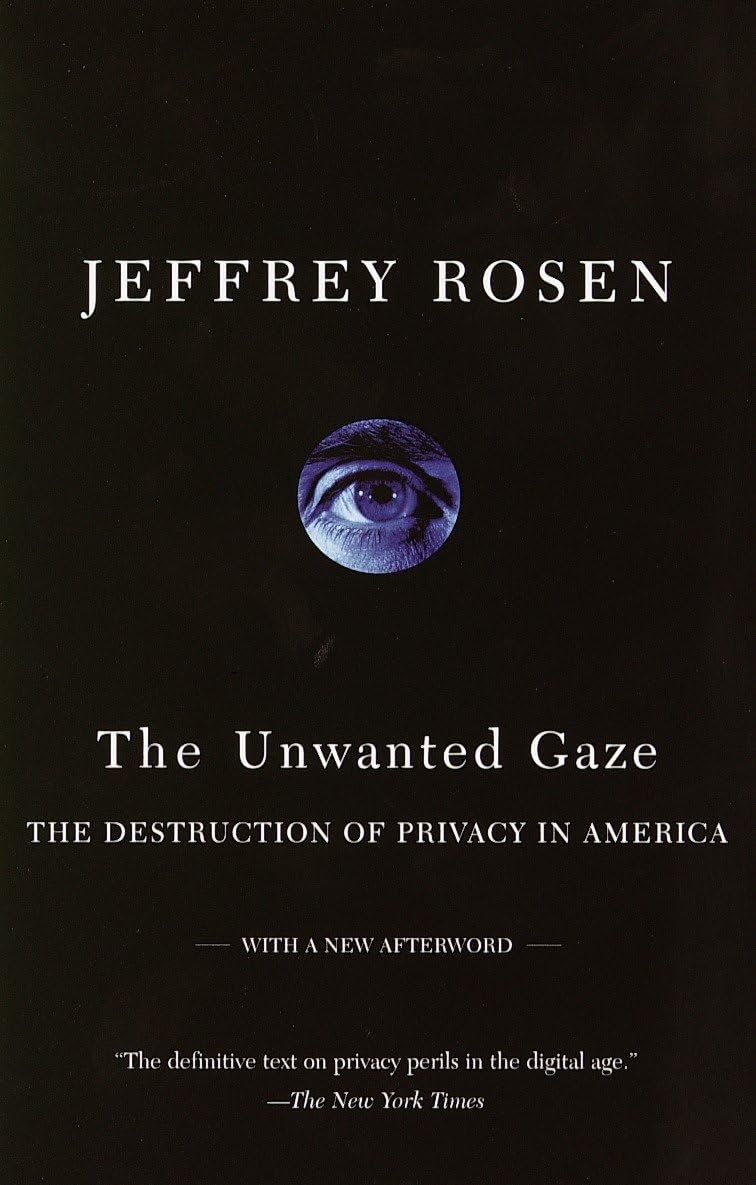
Description
The Unwanted Gaze is an important book about one of the most pressing issues of our day: how changes in technology and the law have combined to demolish our rights of privacy, and what we can and must do to re-secure them. In a world in which Ken Starr can subpoena Monica Lewinsky's bookstore receipts and deleted e-mail messages can be used as justification for firing employees, it's clear that private information of all kinds can be taken out of context and wielded against us. Where exactly did our constitutional guarantees on privacy go? In superbly lucid prose, Jeffrey Rosen tells not only where those privacy rights went but also how we can get them back. The Unwanted Gaze is utterly indispensable for anyone who cares about the future of his or her private life. "Brilliant and haunting…a pleasure to read."– The Washington Post Book World “Rosen makes a complex subject fascinating by showing us how vulnerable we all are. His message: Pay attention. It could happen to you.”– The Denver Post “This remarkably rich and detailed book sharpens our understanding of a problem that most of us prefer not to think about.”– The New York Times Book Review The Unwanted Gaze is an important book about one of the most pressing issues of our day: how changes in technology and the law have combined to demolish our rights of privacy, and what we can and must do to re-secure them. In a world in which Ken Starr can subpoena Monica Lewinsky?s bookstore receipts and deleted e-mail messages can be used as justification for firing employees, it?s clear that private information of all kinds can be taken out of context and wielded against us. Where exactly did our constitutional guarantees on privacy go? In superbly lucid prose, Jeffrey Rosen tells not only where those privacy rights went but also how we can get them back. The Unwanted Gaze is utterly indispensable for anyone who cares about the future of his or her private life. The Unwanted Gaze" is an important book about one of the most pressing issues of our day: how changes in technology and the law have combined to demolish our rights of privacy, and what we can and must do to re-secure them. In a world in which Ken Starr can subpoena Monica Lewinsky's bookstore receipts and deleted e-mail messages can be used as justification for firing employees, it's clear that private information of all kinds can be taken out of context and wielded against us. Where exactly did our constitutional guarantees on privacy go? In superbly lucid prose, Jeffrey Rosen tells not only where those privacy rights went but also how we can get them back. The Unwanted Gaze is utterly indispensable for anyone who cares about the future of his or her private life. Jeffrey Rosen is an associate professor at the George Washington University Law School and legal affairs editor of The New Republic . He is a graduate of Harvard College; Balliol College, Oxford, where he was a Marshall Scholar; and Yale Law School. His essays and book reviews have appeared in many publications, including The New York Times Magazine and The New Yorker . He lives in Washington, D.C. Prologue The Unwanted Gaze This book began as an effort to understand the constitutional, legal, and political drama that culminated in the impeachment and acquittal of President Bill Clinton. But that strange and singular confluence of events prompted me to think about the Clinton impeachment as a window onto a less unusual phenomenon that affects all Americans: namely, the erosion of privacy, at home, at work, and in cyberspace, so that intimate personal information—from diaries, e-mail, and computer files to records of the books we read and the Web sites we browse—is increasingly vulnerable to being wrenched out of context and exposed to the world. What follows is an attempt to explore the legal, technological, and cultural changes that have undermined our ability to control how much information about ourselves is communicated to others. I would also like to consider ways of reconstructing some of the zones of privacy that law and technology have been allowed to invade. In January of 1998, when Kenneth Starr began to examine allegations that President Clinton had lied under oath about an adulterous affair, I became interested in trying to identify the legal forces that converged in Paula Jones’s sexual harassment suit and in the subsequent impeachment investigation. Why, for example, were Jones’s lawyers permitted to go on a fishing expedition into the President’s sexual history, asking him to identify all the women with whom he had sexual relations as governor and president? Merely by accusing Clinton of an unwanted advance, Jones was able to violate not only his privacy but also that of Monica Lewinsky, who was forced to describe her own consensual sexual activities under oath. How could the law permit such unreasonable searches, in which the investigation of the offense seemed more invasive than the offense it
More Information
| Color | Black |
| Gtin | 09780679765202 |
| Mpn | Part_0679765204 |
| Age_group | ADULT |
| Condition | NEW |
| Gender | UNISEX |
| Product_category | Gl_book |
| Google_product_category | Media > Books |
| Product_type | Books > Subjects > Engineering & Transportation > Engineering > Electrical & Electronics > Digital Design |