
Description
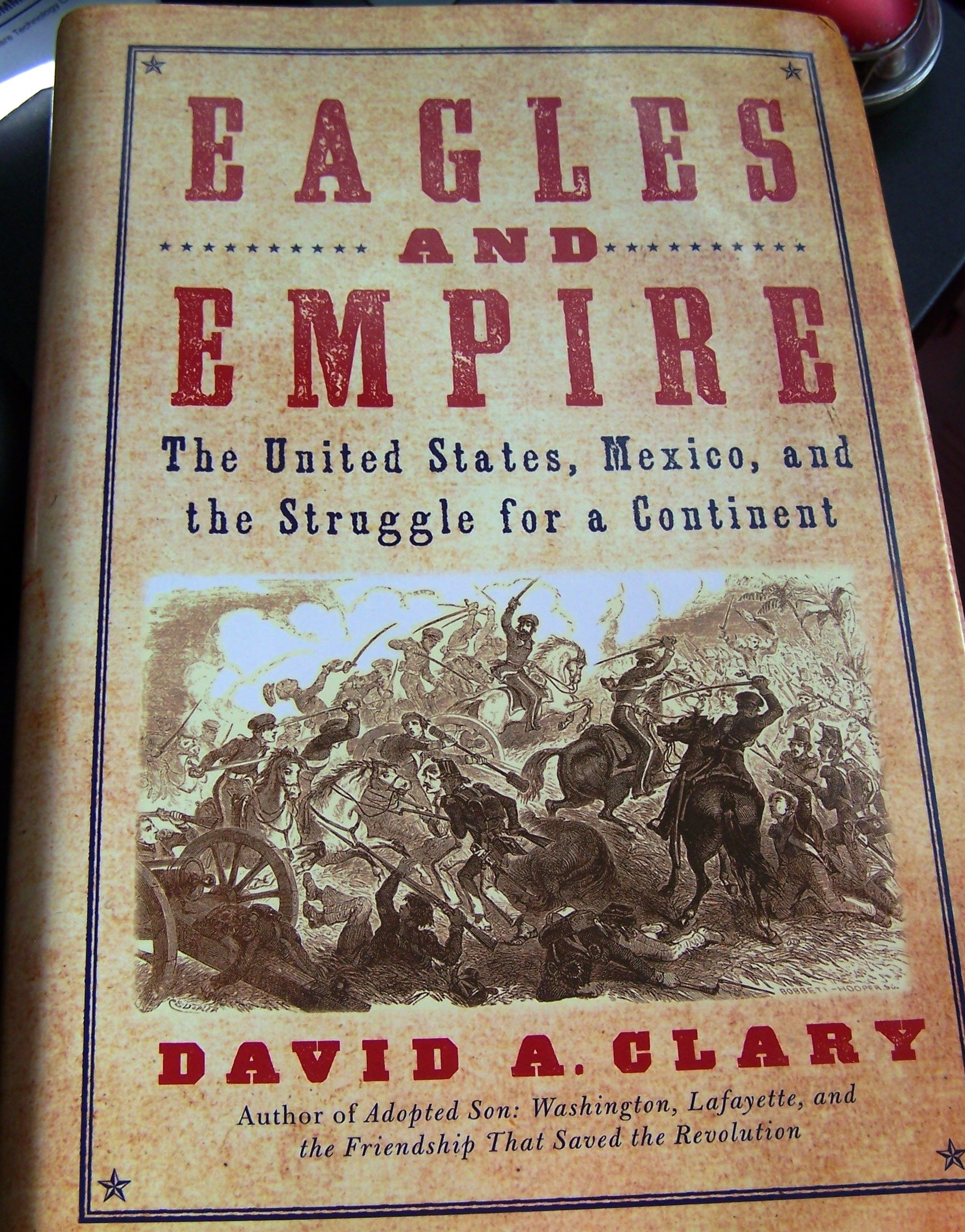
A war that started under questionable pretexts. A president who is convinced of his country’s might and right. A military and political stalemate with United States troops occupying a foreign land against a stubborn and deadly insurgency. The time is the 1840s. The enemy is Mexico. And the war is one of the least known and most important in both Mexican and United States history—a war that really began much earlier and whose consequences still echo today. Acclaimed historian David A. Clary presents this epic struggle for a continent for the first time from both sides, using original Mexican and North American sources. To Mexico, the yanqui illegals pouring into her territories of Texas and California threatened Mexican sovereignty and security. To North Americans, they manifested their destiny to rule the continent. Two nations, each raising an eagle as her standard, blustered and blundered into a war because no one on either side was brave enough to resist the march into it. In Eagles and Empire , Clary draws vivid portraits of the period’s most fascinating characters, from the cold-eyed, stubborn United States president James K. Polk to Mexico’s flamboyant and corrupt general-president-dictator Antonio López de Santa Anna; from the legendary and ruthless explorer John Charles Frémont and his guide Kit Carson to the “Angel of Monterey” and the “Boy Heroes” of Chapultepec; from future presidents such as Benito Juárez and Zachary Taylor to soldiers who became famous in both the Mexican and North American civil wars that soon followed. Here also are the Irish Soldiers of Mexico and the Yankee sailors of two squadrons, hero-bandits and fighting Indians of both nations, guerrilleros and Texas Rangers, and some amazing women soldiers. From the fall of the Alamo and harrowing marches of thousands of miles in the wilderness to the bloody, dramatic conquest of Mexico City and the insurgency that continued to resist, this is a riveting narrative history that weaves together events on the front lines—where Indian raids, guerrilla attacks, and atrocities were matched by stunning acts of heroism and sacrifice—with battles on two home fronts—political backstabbing, civil uprisings, and battle lines between Union and Confederacy and Mexican Federalists and Centralists already being drawn. The definitive account of a defining war, Eagles and Empire is page-turning history—a book not to be missed. “A lively history.”— Kirkus David A. Clary, former chief historian of the US Forest Service, is the author of Adopted Son: Washington, Lafayette, and the Friendship That Saved the Revolution . He has been a consultant to government agencies and has taught history at the university level. He lives in Roswell, New Mexico with his wife, Beatriz. Chaper One THIS YOUNG MAN WILL LIVE TO MAKE HIS COUNTRY WEEP (1783-1823) The history of Mexico since 1822 might accurately be called the history of Santa Anna's revolutions. . . . His name plays the major role in all the political events of the country, and its destiny has become intertwined with his. —Lucas Alaman Lieutenant General Don Juan de O'Donoju landed in Vera Cruz on July 30, 1821. His job was to implement the Spanish Constitution of 1812, but he turned out to be the last Spanish viceroy of New Spain. The city was under siege by a small army of insurgents, led by a former royalist officer—New Spain had risen up against Old Spain, because the Criollos (Creoles, native-born descendants of Spaniards) objected to that liberal constitution. Government might be nominally imposed by the king back in the Iberian Peninsula—implemented by native-Spanish officers known as Peninsulares, in America more commonly called Gachupines (an insult suggesting foppishness)—but their numbers were small. The real power was in the hands of greater numbers of criollo soldiers, priests, and landowners. The liberal constitution would deprive them of their privileges, so they rebelled. The young officer besieging Vera Cruz was famous for unprincipled opportunism. Not long ago he had been a captain in the royal colonial army; a small victory over the rebels earned him the rank of lieutenant colonel, but then he offered to change sides if it gained him another promotion. It did, and he became a colonel among the insurgents. When the whole fray was over he was a brigadier general and right-hand man to the new ruler of independent New Spain, Agustin de Iturbide. The besieging officer arranged a meeting between O'Donoju and Iturbide, and on August 24, 1821, the two signed the Treaty of Cordoba, granting independence to New Spain. The officer next marched against the remaining royalist garrisons inland, obtained their surrenders, and returned to Vera Cruz to finish the insurgent business there. Royalist holdouts, sheltered in the island fortress San Juan de Ullua in the city's harbor, gave up late in October. O'Donoju got to know this officer well. He was a handsome fellow, born to wear his
More Information
| Gtin | 9780553806526 |
| Mpn | BC9780553806526 |
| Age_group | ADULT |
| Condition | NEW |
| Gender | UNISEX |
| Product_category | Gl_book |
| Google_product_category | Media > Books |
| Product_type | Books > Subjects > History > Americas > United States > State & Local |