
Description
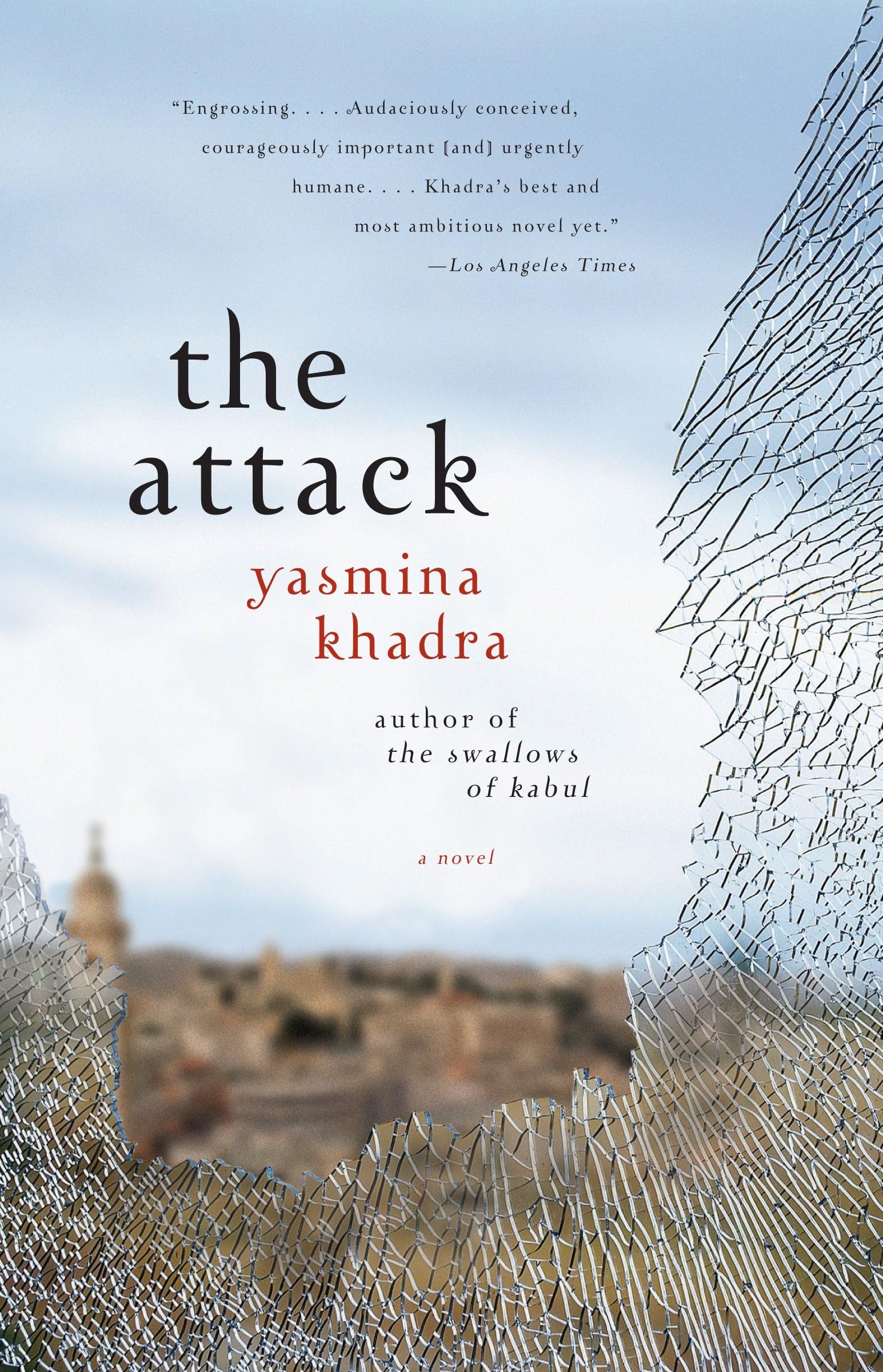
From the bestselling author of The Swallows of Kabul comes this timely and haunting novel that powerfully illuminates the devastating human costs of terrorism.Dr. Amin Jaafari is an Arab-Israeli surgeon at a hospital in Tel Aviv. As an admired and respected member of his community, he has carved a space for himself and his wife, Sihem, at the crossroads of two troubled societies. Jaafari’s world is abruptly shattered when Sihem is killed in a suicide bombing.As evidence mounts that Sihem could have been responsible for the catastrophic bombing, Jaafari begins a tortured search for answers. Faced with the ultimate betrayal, he must find a way to reconcile his cherished memories of his wife with the growing realization that she may have had another life, one that was entirely removed from the comfortable, modern existence that they shared. “Engrossing…audaciously conceived, courageously important [and] urgently humane, The Attack is Khadra’s best and most ambitious novel yet.” — The Los Angeles Time “A genuine work of art.” — The Philadelphia Inquirer “Gripping, dynamic. . . .Both a fierce rendering of geopolitical tensions and a plea for peace.” — Tne New York Times “A powerfully dark vision . . . of the [Arab-Israeli] conflict.” — The New Yorker “An engaging glimpse into the kinds of stories we never hear on CNN.” — TimeOut Chicago YASMINA KHADRA is the pen name of the former Algerian army officer Mohammed Moulessehoul. He adopted his wife's name as a pseudonym to avoid military censorship. He is the author of more than 20 books, at least six of which have been published in English, among them The Swallows of Kabul and The Attack , both shortlisted for the IMPAC literary award. Khadra’s work has been published in 45 countries. He has twice been honored by the Académie française, winning both the Médaille de vermeil (2001) and Grand Prix de littérature (2012). His latest novel is The Angels Die (2016). He lives in France. The New York Times describes Khadra as, “a writer who can understand man wherever he is.” After the operation, Ezra Benhaim, our hospital director, comes to see me in my office. He's an alert, lively gentleman, despite his sixty-odd years and his increasing corpulence. Around the hospital, he's known as "the Sergeant," because he's an outrageous despot with a sense of humor that always seems to show up a little late. But when the going gets tough, he's the first to roll up his sleeves and the last to leave the shop. Before I became a naturalized Israeli citizen, back when I was a young surgeon moving heaven and earth to get licensed, he was there. Even though he was still just a modest chief of service at the time, he used the little influence his position afforded him to keep my detractors at bay. In those days, it was hard for a son of Bedouins to join the brotherhood of the highly educated elite without provoking a sort of reflexive disgust. The other medical school graduates in my class were wealthy young Jews who wore gold chain bracelets and parked their convertibles in the hospital lot. They looked down their noses at me and perceived each of my successes as a threat to their social standing. And so, whenever one of them pushed me too far, Ezra wouldn't even want to know who started first; he took my side as a matter of course. He pushes the door open without knocking, comes in, and looks at me with his head tilted to one side and the hint of a smile on his lips. This is his way of communicating his satisfaction. Then, after I pivot my armchair to face him, he takes off his glasses, wipes them on the front of his lab coat, and says, "It looks like you had to go all the way to the next world to bring your patient back." "Let's not exaggerate." He puts his glasses back on his nose, flares his unattractive nostrils, nods his head; then, after a brief meditation, his face regains its austerity. "Are you coming to the club this evening?" "Not possible. My wife's due home tonight." "What about our return match?" "Which one? You haven't won a single game against me." "You're not fair, Amin. You always take advantage of my bad days and score lots of points. But today, when I feel great, you back out." I lean far back in my chair so I can stare at him properly. "You know what it is, my poor old Ezra? You don't have as much punch as you used to, and I hate myself for taking advantage of you." "Don't bury me quite yet. Sooner or later, I'm going to shut you up once and for all." "You don't need a racket for that. A simple suspension would do the trick." He promises to think about it, brings a finger to his temple in a casual salute, and goes back to badgering the nurses in the corridors. Once I'm alone, I try to go back to where I was before Ezra's intrusion and remember that I was about to call my wife. I pick up the phone, dial our number, and hang up again at the end of the seventh ring. My watch reads 1:12 p.m. If Sihem took the nine o'clock bus, she should have a
More Information
| Color | Multicolor |
| Gtin | 09780307275707 |
| Mpn | 9780307275707 |
| Age_group | ADULT |
| Condition | NEW |
| Gender | UNISEX |
| Product_category | Gl_book |
| Google_product_category | Media > Books |
| Product_type | Books > Subjects > Literature & Fiction > Genre Fiction > Historical > Cultural Heritage |