
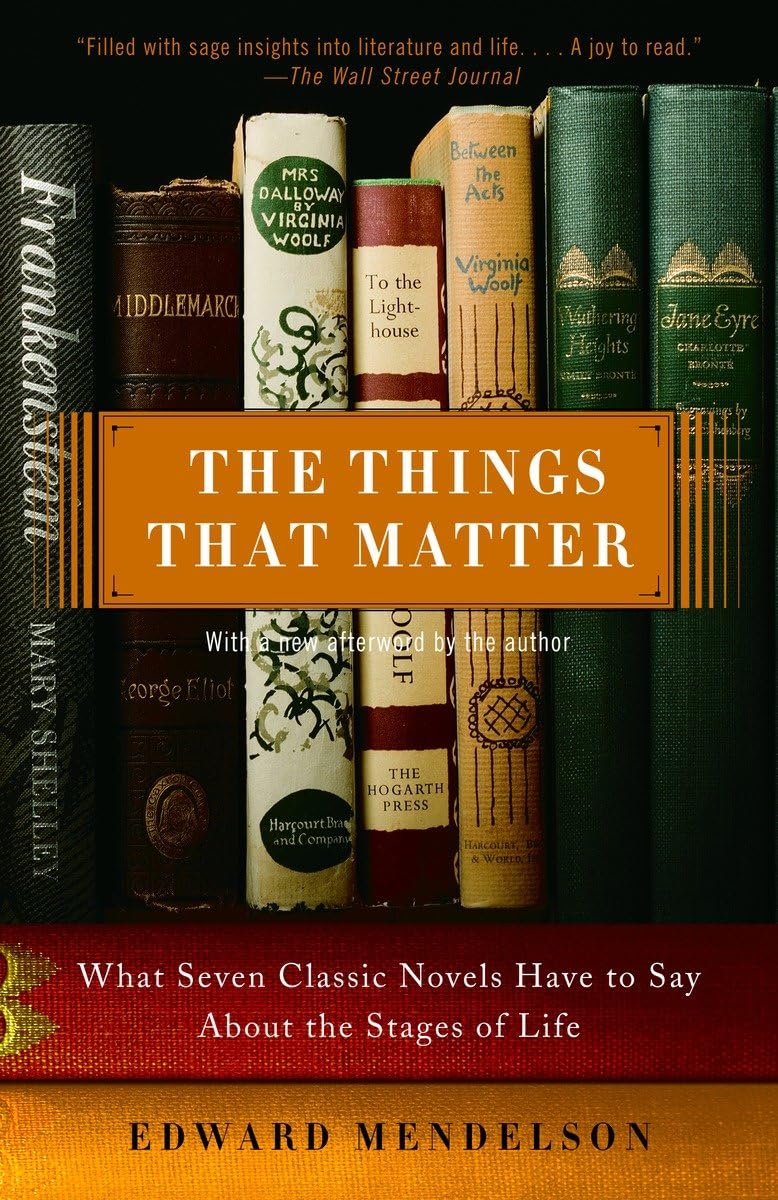
Description
She felt rather inclined just for a moment to stand still after all that chatter, and pick out one particular thing; the thing that mattered . . . — Virginia Woolf, To The Lighthouse An illuminating exploration of how seven of the greatest English novels of the nineteenth and twentieth centuries— Frankenstein, Wuthering Heights, Jane Eyre, Middlemarch, Mrs. Dalloway, To the Lighthouse, and Between the Acts —portray the essential experiences of life. Edward Mendelson—a professor of English at Columbia University—illustrates how each novel is a living portrait of the human condition while expressing its author’s complex individuality and intentions and emerging from the author’s life and times. He explores Frankenstein as a searing representation of child neglect and abandonment and Mrs. Dalloway as a portrait of an ideal but almost impossible adult love, and leads us to a fresh and fascinating new understanding of each of the seven novels, reminding us—in the most captivating way—why they matter. “Filled with sage insights into literature and life. . . . A joy to read.”— The Wall Street Journal “Dazzling. . . . The highest achievement of literary criticism is to make the reader hunger to go back to the book and reconfirm what has been opened up.”— The New York Times Book Review “Masterful. . . . Filled with surprises and delights. Fluid, wide and deep, The Things That Matter takes a rightful place next to the literature we love.”— The Washington Times Edward Mendelson is a professor of English Literature at Columbia University. He is the literary executor of the Estate of W.H. Auden and is the author of the biographies of Early Auden and Later Auden . He has written essays on and prepared editions of George Meredith, Thomas Hardy, H.G. Wells, Arnold Bennett, Virginia Woolf, Samuel Beckett, and Thomas Pynchon, among others. He lives in New York City. 1 birth: Frankenstein Frankenstein is the story of childbirth as it would be if it had been invented by someone who wanted power more than love. The book’s subtitle identifies Victor Frankenstein as “The Modern Prometheus.” The ancient Prometheus stole fire from the gods so that he could give human beings its warmth and comfort. The modern Prometheus steals from nature “the cause of generation and life”—the secret of biological reproduction by which a new life is brought into being—and uses that secret to create a new species. In human beings the power of “generation and life” works through the partly instinctual, partly voluntary union of a man and woman who have little control over the outcome, and who typically feel—as Victor remembers his parents feeling about him—a “deep consciousness of what they owed towards the being to which they had given life.” Victor, in contrast, feels no obligation to the being to which he has given life through “the horrors of my secret toil,” and he sustains himself through his gruesome, pleasureless work with the thought that his creature will owe him more gratitude than any human child ever owed to its father. Frankenstein performs the act of creation alone, by conscious choice rather than through instinct, so that he alone can have total control over its outcome. Victor creates new life by applying an electric spark to a dead body, not by embracing a living one. In this act and in every other he rejects his own bodily life, the bodily lives of those who love him, and the whole realm of the flesh. While building his creature, he “tortured the living animal to animate the lifeless clay.” Later, while building a mate for the creature, Victor is so horrified by the prospect of their having children of their own that, “trembling with passion,” he “tore to pieces the thing on which I was engaged.” Victor thinks of his own impending marriage with “horror and dismay,” and some of his feelings are justified by his creature’s threat to be “with you on your wedding-night.” But the deeper cause of his dismay is something that the book never names explicitly, but which it insistently points to—Victor’s deep, unacknowledged horror of the human body and its relations with another human body. One effect of what he calls his “murderous machinations” is the murder of his own bride on their wedding night. Choosing Beauty The body is the part of yourself which is most obviously created and shaped by nature. No one can ever fully control its appetites, instincts, and desires, especially the impulses that erupt without warning at the end of childhood, when the body becomes sexually mature. Everyone wants to achieve at least some control over them, but Victor Frankenstein wants the total control over the flesh that he can attain by making a body to his own specification. His ambition is not merely to gain control over his own body—although he drives it to exhaustion and withholds satisfactions from it—but to conquer nature itself, to seize for his own use that mysterious instinctive power that gave his body life. “I pursued n
More Information
| Color | Black |
| Gtin | 09780307275226 |
| Mpn | 9780307275226 |
| Age_group | ADULT |
| Condition | NEW |
| Gender | UNISEX |
| Product_category | Gl_book |
| Google_product_category | Media > Books |
| Product_type | Books > Subjects > Literature & Fiction > History & Criticism > Books & Reading > General |