
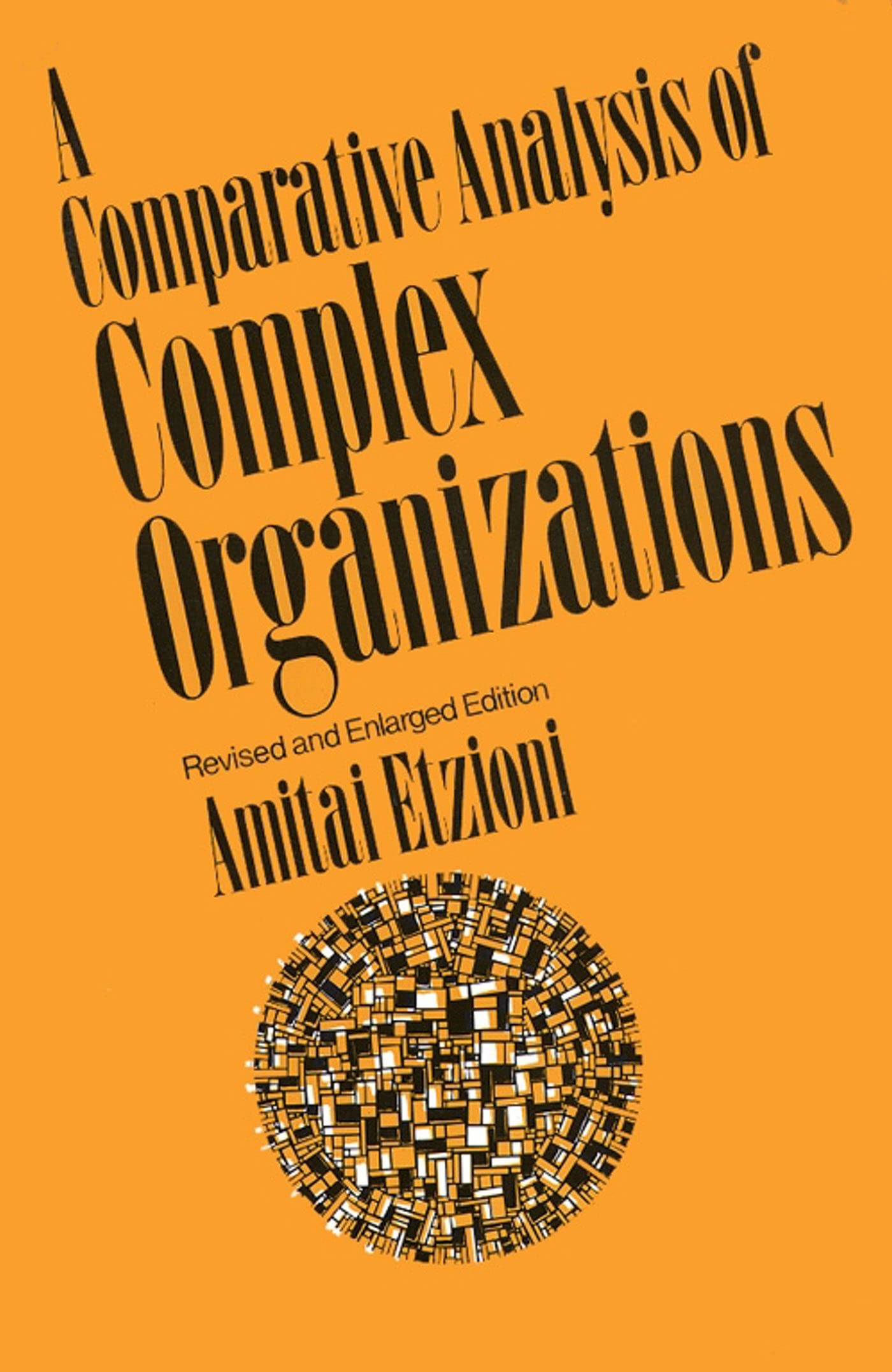
Description
This important book “classifies organizations on the basis of organizational properties and systemically examines variations amount different types of organization” ( American Sociological Review). Bringing light to a neglected field, A Comparative Analysis of Complex Organizations presents models for the analysis of various organizational types and examines how they are constructed. Primarily discussing the relationship between compliance and each variable it introduces, this book works as a cornerstone for the comparative analysis of organizations. American Sociological Review This is an important book....It classifies organizations on the basis of organizational properties and systematically examines variations among different types of organization....The scope of Etizioni's approach include a wide variety of organizations, from religious societies to concentration camps...valuable reading for all students of organization. The Annals American Academy of Political and Social Science ...a challenging and fresh approach to an important area which has, in general, leaned too closely and too heavily for too long a time on the giant contributions of Max Weber. American Political Science Review ....the analysis of Charisma, and the critique of Weber's well-known discussion of this phenomenon, are among the best things in the book. Personnel Psychology Etzioni breaks into new territory....Perhaps now the ideas planted so long ago by Barnard and Simon will receive the nurture which they so deserve...a contribution of significance. Amitai Etzioni is Professor of Sociology at Columbia University and Director of the Center for Policy Research. His other books include Political Unification and The Active Society: A Theory of Societal and Political Processes. Chapter 1 COMPLIANCE AS A COMPARATIVE BASE A DEFINITION OF COMPLIANCE Compliance is universal, existing in all social units. It is a major element of the relationship between those who have power and those over whom they exercise it (Simmel, 1896). Despite its universality, it has been chosen as a base for this comparative study because it is a central element of organizational structure. The emphasis on compliance within the organization differentiates the latter from other types of social units. Characteristics of organizations such as their specificity, size, complexity and effectiveness each enhances the need for compliance. And in turn, compliance is systematically related to many central organizational variables. Compliance refers both to a relation in which an actor behaves in accordance with a directive supported by another actor's power, and to the orientation of the subordinated actor to the power applied. By supported we mean that those who have power manipulate means which they command in such a manner that certain other actors find following the directive rewarding, while not following it incurs deprivations. In this sense, compliance relations are asymmetric (or "vertical"). But it is not assumed that the subordinates have no power, only that they have less. The power- means, manipulated to support the directives, include physical, material, and symbolic rewards and deprivations. Organizations tend to allocate these means systematically and strive to ensure that they will be used in conformity with the organizational norms. The orientation of the subordinated actor can be characterized as positive (commitment) or negative (alienation). It is determined in part by the degree to which the power applied is considered legitimate by the subordinated actor, and in part by its congruence with the line of action he would desire. We refer to this orientation, whether positive or negative, as involvement in the organization. In sum, there are two parties to a compliance relationship: an actor who exercises power, and an actor, subject to this power, who responds to this subjection with either more or less alienation or more or less commitment. The next task is to use compliance as here defined to develop an analytical base for the classification of organizations. This is done in three steps. First, three kinds of power are differentiated; then, three kinds of involvement are specified; and finally, the associations of kinds of power with kinds of involvement are indicated. These associations -- which constitute compliance relationships -- then serve as the basis of our classification of organizations. THREE KINDS OF POWER: A COMPARATIVE DIMENSION A Classification of Power Power is an actor's ability to induce or influence another actor to carry out his directives or any other norms he supports. Goldhamer and Shils state that "a person may be said to have power to the extent that he influences the behavior of others in accordance with his own intentions." (p. 171). Of course, "his own intentions" might be to influence a person to follow others' "intentions" or those of a collectivity. In organizations, enf
More Information
| Color | Other |
| Gtin | 09780029096208 |
| Mpn | B01K2QGH58 |
| Age_group | ADULT |
| Condition | NEW |
| Gender | UNISEX |
| Product_category | Gl_book |
| Google_product_category | Media > Books |
| Product_type | Books > Subjects > Business & Money > Processes & Infrastructure > Organizational Learning |